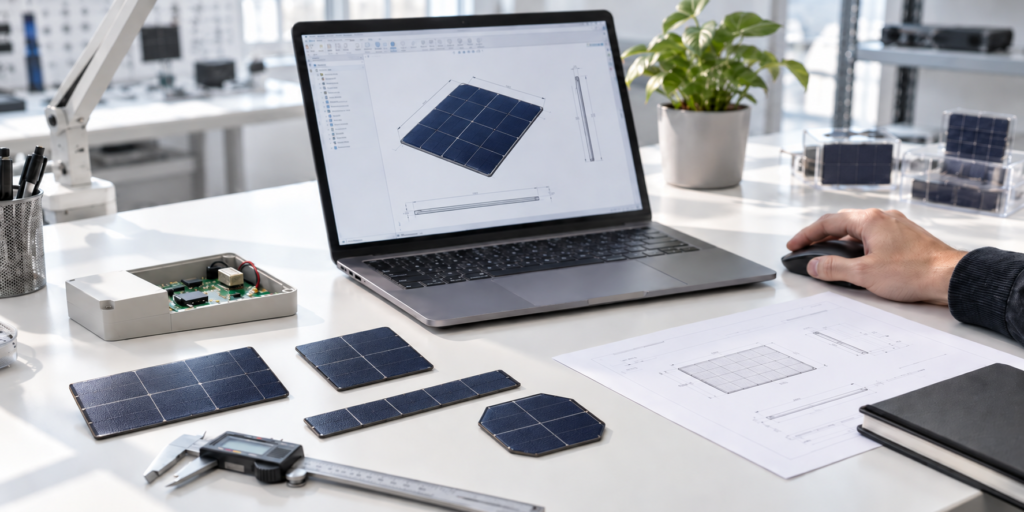
Semi-flexible solar panel mounting should be selected with the panel construction and supporting surface. A mounting method that works for one module and substrate may create stress, heat or maintenance problems on another. We begin by defining what supports the panel and how the installation will be inspected and replaced.
This is a selection guide for product teams. Use the instructions for the chosen module, substrate and mounting materials to define the installation process. There is no universal adhesive spacing, screw pattern or bend limit for every semi-flexible panel.
Define the loads and the support
Record the substrate, curvature, local surface changes, movement and relevant exposure. Include handling during installation and service, rather than considering only the final parked condition. The module should not bridge unsupported features unless its design explicitly allows it.
Ask the supplier which areas require support and where retention loads may be applied. A mounting hole does not automatically permit unlimited clamping force, and a thin panel should not be pulled into an unsuitable contour by its fasteners.
When to consider adhesive bonding
Bonding may be considered when the product needs a low-profile installation or the structure should avoid certain penetrations. The decision depends on compatibility with the panel back surface and the substrate, as well as the preparation and curing process.
Request guidance from the material suppliers and validate the actual combination. Roof coatings, paint, contamination and surface ageing can change the interface. Include allowable process conditions and the inspection method in the work instruction.
Also plan removal. A permanent bond can make replacement more difficult and may affect the underlying finish. The installation review should include what a technician must do if the panel is damaged, rather than assuming that it will never require service.
When to consider mechanical retention
Frames, approved fasteners or supporting assemblies can provide a defined and potentially serviceable retention method. They introduce their own requirements for clearance, contact surfaces, sealing and the distribution of force.
Use only retention locations and methods approved for the selected module. Do not add holes or concentrate loads at an unapproved edge. If the design uses an intermediate support, assess the support and the panel as one mounted assembly.
Removable systems need their own validation
A removable panel may be attractive where access, seasonal use or replacement matters. However, repeated attachment, cable movement and the possibility of incomplete installation become part of the operating requirement.
Define how the user can recognize correct attachment, where the disconnected cable is stored and how the system handles vibration or handling. A convenient release mechanism is useful only if retention and electrical interfaces remain suitable throughout the intended use.
Compare the methods against the product
| Question | What to compare |
|---|---|
| Surface compatibility | Panel back surface, substrate and preparation requirements |
| Load transfer | Support, retention locations and local pressure |
| Thermal and water behaviour | Complete assembly under its actual exposure |
| Installation consistency | Process controls, tools and inspection access |
| Service | Removal, replacement and effect on the supporting surface |
Review cable routing at the same time
Mounting can leave a cable trapped, sharply bent or exposed to rubbing. Show the cable exit and connection route on the installation drawing. Keep handling forces from being transferred to the module termination and provide inspection access where needed.
If the panel is removable, test the sequence of disconnecting, releasing, storing and reinstalling it. The mechanical and electrical sequence should follow the approved equipment instructions.
Approve a process rather than a photograph
Build representative samples using the intended substrate and assembly method. Define the mechanical, environmental and functional checks from the actual risks. Record materials, preparation, curing conditions where relevant, panel revision and acceptance criteria.
Then repeat the installation process to see whether it is practical to control. A successful sample made by an engineer does not establish that installers can reproduce it consistently without clear instructions.
Our semi-flexible solar panel options can be reviewed alongside your proposed mounting system. Send the surface drawing, material information and service requirements so we can identify the module interfaces that need confirmation.