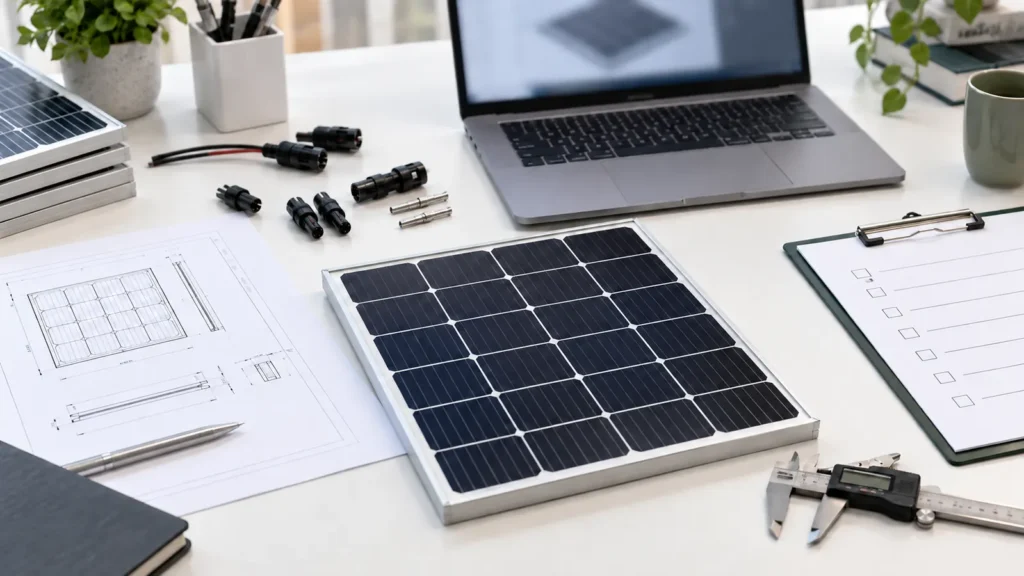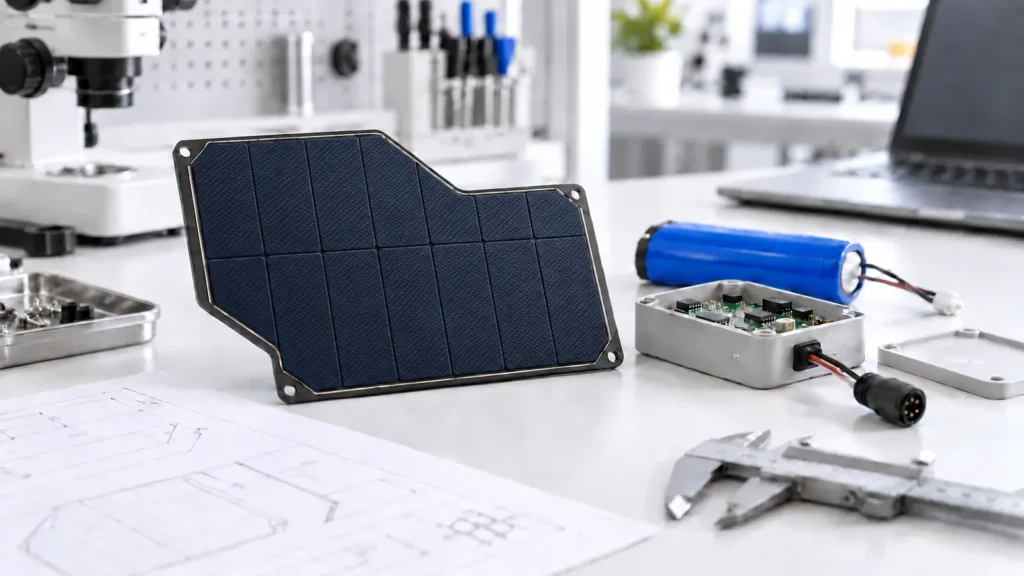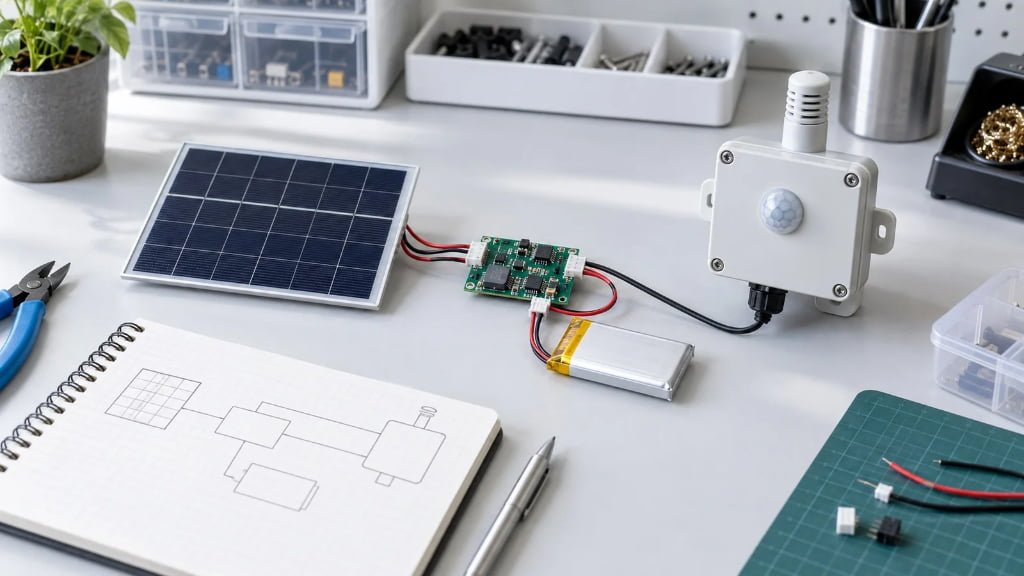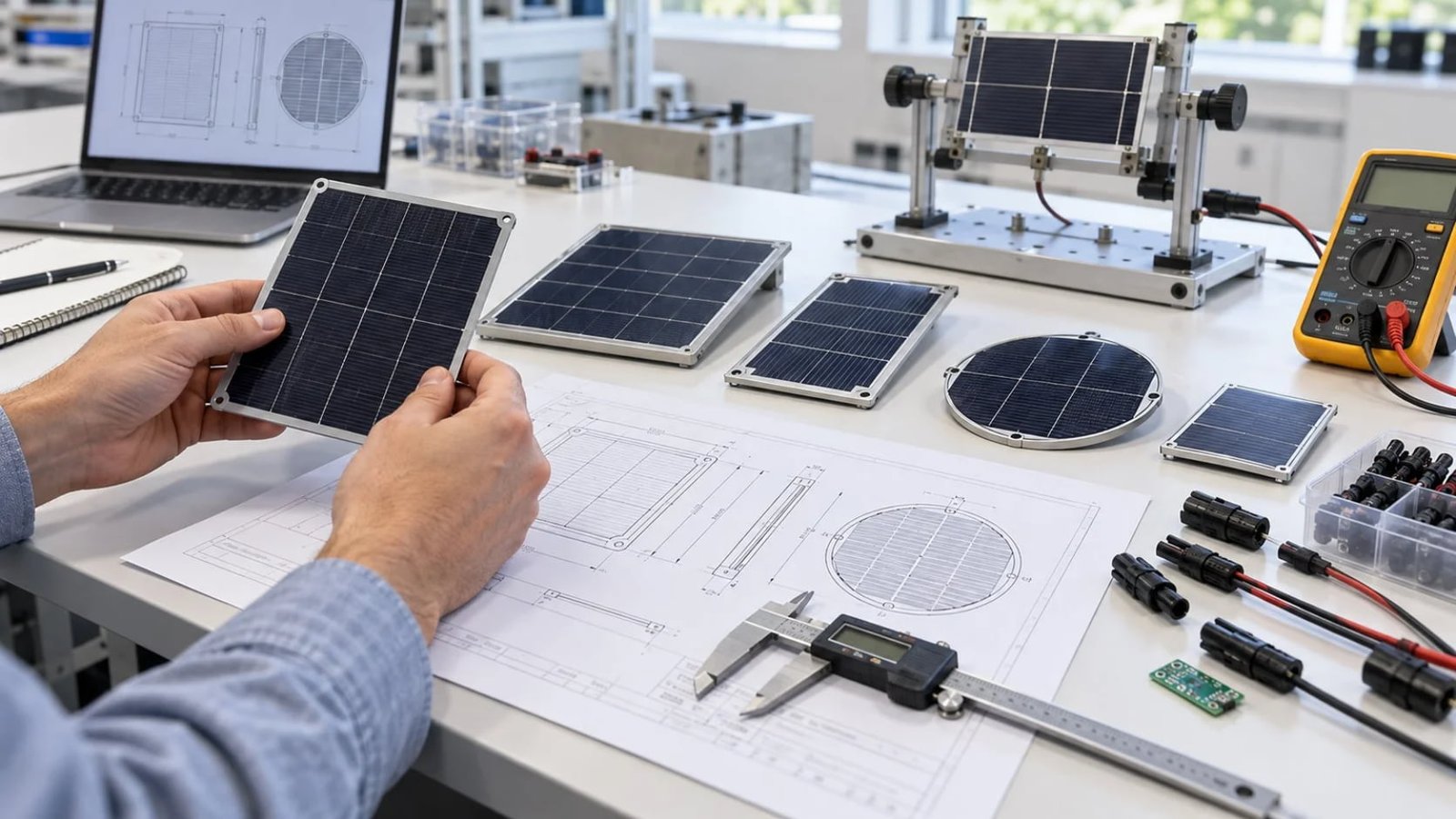
Choosing a custom solar panel manufacturer is not the same as buying a standard module from a catalog. For an embedded product, the panel must fit the available space, match the charging electronics, survive the operating environment, and remain consistent when the project moves from prototype to volume production.
This guide explains what product developers, purchasing teams, and OEM brands should evaluate before selecting a manufacturing partner.
Start With Engineering Capability, Not Only Unit Price
A low quotation can be attractive, but the lowest unit price does not always produce the lowest total project cost. A poorly matched panel can lead to redesign work, delayed validation, unstable charging, field failures, or repeated tooling changes.
A capable supplier should be able to review the project as a system:
- Available installation area and product geometry
- Required voltage, current, and daily energy output
- Battery type and charging circuit
- Indoor or outdoor light conditions
- Mounting, cable exit, and connector requirements
- Environmental and lifetime expectations
- Prototype quantity and expected annual volume
1. Check Whether the Supplier Understands Your Application
A reliable custom solar panel manufacturer should ask questions before recommending a construction. If a supplier immediately quotes from only length, width, and wattage, important risks may be missed.
Useful questions include where the product will be used, how often it operates, how much light reaches the panel, whether partial shading is common, and whether the panel is integrated into an enclosure or mounted externally.
For example, an outdoor asset tracker has different requirements from an indoor electronic shelf label using a rigid indoor perovskite solar panel. A portable charger also requires a different mechanical design from a small custom solar panel bonded to a sensor housing.
2. Review the Available Cell and Material Options
Different projects may require crystalline silicon, back-contact cells, thin-film technologies, or indoor photovoltaic solutions. The front surface may use ETFE, PET, or glass, depending on weight, durability, appearance, and cost requirements. Use an ETFE vs. PET solar panel comparison to structure the material review around the actual environment and laminate.
The supplier should explain why a particular combination is appropriate instead of simply promoting the most expensive material. Ask for a comparison that covers:
- Power density
- Outdoor durability
- Thickness and weight
- Surface appearance
- Flexibility or rigidity
- Expected production stability
- Target cost
3. Confirm Electrical Design Support
Solar panel voltage should be matched to the charging circuit, not selected only from the nominal battery voltage. A 3.7V lithium battery, for example, may require a panel configuration designed around the input range of the charging IC and the expected operating temperature.
A strong supplier should be able to discuss operating voltage, open-circuit voltage, current, power tolerance, cell layout, and the effect of real light conditions. For low-power devices, daily energy balance is usually more important than peak wattage alone.
Before requesting a quotation, prepare the device’s active current, sleep current, duty cycle, battery capacity, charging circuit information, and expected hours of useful light.
4. Evaluate Mechanical Customization
Custom engineering often includes much more than panel dimensions. Depending on the application, you may need:
- Non-standard shapes or cutouts
- Rounded corners
- Specific thickness limits
- Adhesive backing
- Mounting holes or eyelets
- Defined cable-exit positions
- Custom cable length
- Small connectors or bare wire ends
- Branding or neutral-label production
Ask the manufacturer to confirm dimensional tolerances and identify which features require tooling. A drawing approval process is especially important before samples and mass production.
5. Ask About Prototyping and Design Verification
Prototype support is one of the clearest signs that a supplier is prepared for OEM development. Treat the initial prototype as an engineering checkpoint: it should expose fit, electrical, and integration risks before the production specification is frozen.
A practical validation process may include dimensional inspection, electrical measurement under controlled conditions, connector polarity checks, adhesion or mounting trials, charging tests with the actual electronics, and application testing in the expected environment.
Ask how design changes are documented and whether a revised drawing, specification, or approved sample will control production.
6. Review Quality Control and Traceability
For repeat orders, consistency matters as much as first-sample performance. Ask the supplier what is checked during incoming inspection, in-process assembly, and final testing.
Relevant controls may include cell sorting, appearance inspection, lamination control, electrical testing, polarity verification, dimensional inspection, cable pull checks, and packaging verification. For critical projects, agree on measurable acceptance criteria before production.
Traceability should connect the shipped batch to production and inspection records. This makes it easier to investigate any future issue.
7. Confirm Production Capacity and Supply Stability
A manufacturer may produce an excellent prototype but still struggle with repeatable volume production. Discuss expected monthly volume, lead time, minimum order quantity, peak-season capacity, and the availability of key materials.
It is also useful to understand how the supplier manages cell or material substitutions. Changes that affect appearance, electrical performance, or durability should require customer approval.
8. Clarify Ownership, Tooling, and Change Control
Before placing an order, confirm who owns any custom tooling, whether tooling can be reused for future orders, and how engineering changes are approved. Drawings should include revision numbers, and both parties should retain the final approved specification.
For OEM and ODM projects, also clarify labeling, packaging artwork, inspection standards, confidentiality expectations, and whether the supplier can support regulatory documentation relevant to the finished product.
Questions to Ask a Potential Supplier
- What information do you need to evaluate our application?
- Can you recommend the cell layout and panel voltage for our charging circuit?
- Which surface material is suitable for our operating environment?
- Can you produce prototypes before tooling or mass production?
- Which dimensions and electrical values will be inspected?
- How are design revisions controlled?
- What are the sample and production lead times?
- How do you manage component or material changes?
- Can you provide batch-level inspection records?
Red Flags to Watch For
Be cautious if a supplier cannot explain the proposed construction, avoids confirming tolerances, provides inconsistent drawings, promises unrealistic output from a very small area, or changes materials without a formal approval process.
Communication quality during the quotation and sampling stages often indicates how efficiently future production issues will be handled.
A Practical Supplier Selection Scorecard
Compare shortlisted suppliers across five areas: application understanding, engineering support, prototype quality, production control, and commercial fit. Price should remain part of the decision, but it should be evaluated together with technical risk, lead time, and long-term consistency.
Frequently Asked Questions
What information should I send for a custom solar panel quotation?
Send the available dimensions, target voltage or charging-circuit input, power or daily energy requirement, operating environment, cable and connector needs, annual quantity, and any drawings or product photos.
Should I choose a factory or a trading company?
The best choice depends on the project. What matters most is transparent engineering communication, controlled production, clear responsibility, and reliable quality documentation.
Can a custom panel use my preferred connector?
Usually yes. Provide the connector part number, mating part, polarity, cable type, and required cable length.
How long does custom development take?
Lead time depends on design complexity, materials, tooling, and testing. Simple dimensional changes are normally faster than new structures requiring tooling.
Is the highest-efficiency cell always the best choice?
No. Efficiency must be balanced with cost, appearance, durability, manufacturability, and stable supply.
Build the Panel Around the Product
The right manufacturing partner helps convert product requirements into a panel that can be produced consistently—not just a sample that works once. Early engineering communication reduces redesign work and makes the transition from concept to production more predictable.
Review SiborTech’s solar application examples and small custom solar panel capabilities. When the requirements are defined, discuss your custom solar project with the engineering team.