Choosing between ETFE and PET for a lightweight solar panel affects more than surface appearance. It influences environmental resistance, mechanical integration, product cost, and the validation plan for the finished assembly. For OEM and ODM teams, the right choice starts with the operating environment and product requirements, not a material label.
This ETFE vs. PET solar panel comparison focuses on small custom solar panels, portable solar chargers, sensors, trackers, and other OEM products rather than large framed glass modules.
What Does the Front Surface Do?
The front layer protects the solar cells while allowing light to reach them. It influences scratch resistance, weather durability, optical performance, flexibility, thickness, weight, surface texture, and visual appearance.
The complete laminate matters as much as the named outer material. Adhesive system, encapsulation, backsheet, cell interconnection, edge design, lamination process, and workmanship all affect performance.
What Is an ETFE Solar Panel?
ETFE is a fluoropolymer material frequently used as the outer surface of lightweight outdoor solar laminates. It is often selected when a product needs low weight, a thin profile, and better resistance to outdoor exposure than a basic PET construction.
ETFE surfaces commonly have a textured finish. In a properly engineered laminate, the material can support portable chargers, outdoor sensors, marine accessories, asset trackers, and panels mounted on mobile equipment.
What Is a PET Solar Panel?
PET is a polyester material used in many compact and cost-sensitive solar products. It can provide a smooth, clean appearance and lightweight construction. PET may be suitable for protected locations, indoor products, short-duty applications, promotional electronics, or products with limited environmental exposure.
Its suitability depends strongly on the PET grade, coating, laminate structure, and operating conditions. The word “PET” alone does not define the lifetime of the finished panel.
ETFE vs. PET: Key Differences
| Factor | ETFE | PET |
|---|---|---|
| Typical positioning | Outdoor-oriented lightweight laminate | Cost-sensitive or more protected application |
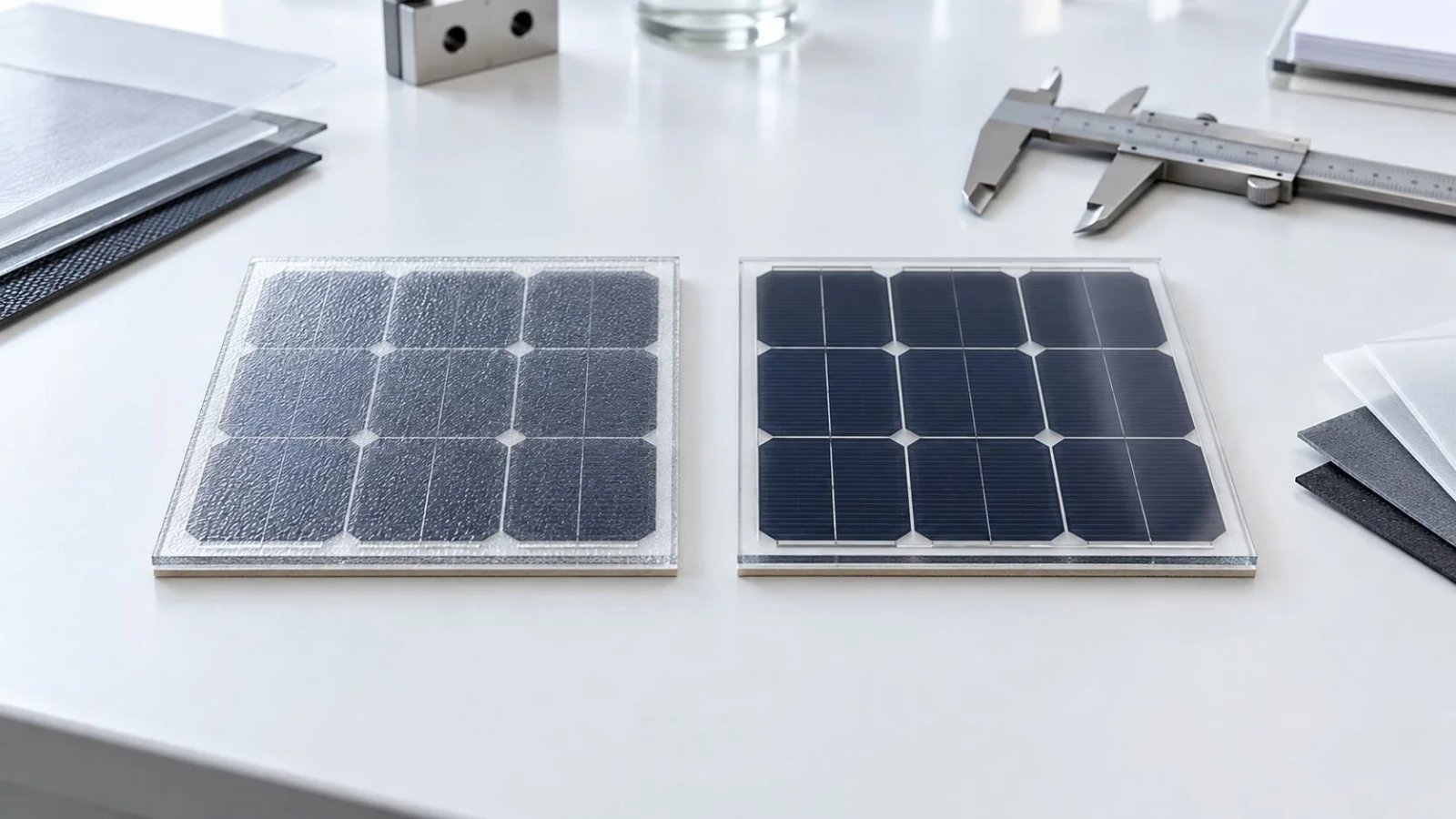
| Surface appearance | Often textured or matte | Often smooth and glossy |
| Outdoor durability | Generally preferred for longer outdoor exposure | More dependent on coating and protection |
| UV resistance | Typically stronger for outdoor designs | Varies by grade and construction |
| Flexibility | Suitable for thin and lightweight laminates | Suitable for thin compact laminates |
| Cost | Usually higher | Usually lower |
| Common uses | Outdoor IoT, portable chargers, marine and mobile products | Indoor electronics, protected sensors, price-sensitive devices |
These are general design tendencies, not guaranteed values. Always compare actual material specifications and test samples from the proposed construction.
1. Outdoor and UV Exposure
For continuous outdoor use, ETFE is usually the stronger starting point because it is commonly selected for weather- and UV-resistant surfaces. PET can discolor, haze, or lose mechanical performance when the grade and coating are not designed for long-term exposure.
However, an ETFE label does not automatically make a panel outdoor-ready. Edge sealing, cable exit, backsheet, encapsulant, and junction design must also prevent moisture-related failures.
2. Surface Texture and Appearance
ETFE panels often show a fine textured surface that can reduce a mirror-like appearance and create a recognizable technical finish. PET panels are often smoother and may appear glossier.
For a consumer-facing product, request physical samples because texture, cell color, busbars, adhesive patterns, and surface reflections can look different from drawings. Appearance requirements should be written into the approved specification.
3. Scratch and Handling Resistance
Portable and exposed products face repeated handling, dust, packing, and abrasion. Surface durability should be evaluated in the real assembly, not inferred from material name alone.
If the panel will be folded, carried, bonded to a housing, or cleaned regularly, test the laminate after realistic handling cycles. Protective films used during production should not be confused with the final functional surface.
4. Flexibility and Mechanical Integration
Both materials can be used in lightweight laminates, but the complete stack determines bending behavior. The solar cells and interconnections still have mechanical limits. A thin panel should not be bent more tightly than its approved radius or twisted during installation.
Define whether the panel is installed on a flat surface, a fixed gentle curve, or a product that flexes repeatedly. Static conformity and repeated dynamic bending are different requirements. For curved or weight-sensitive installations, review the construction options used in semi-flexible solar panels.
5. Optical Performance
The front material and texture influence how light enters the laminate, but solar-cell efficiency, active area, cell spacing, and electrical layout usually have a larger effect on rated output.
When comparing samples, use the same cell technology, dimensions, and test conditions. Otherwise, differences attributed to ETFE or PET may actually come from the cells or layout.
6. Thickness and Weight
ETFE and PET constructions are both much lighter than conventional framed glass modules. This makes them useful for handheld devices, portable chargers, trackers, and enclosures with strict weight limits.
Ask for total laminate thickness and weight per panel. Include any backing plate, adhesive, cable, connector, fabric, or enclosure components in the final product assessment.
7. Cost and Product Lifetime
PET is often chosen to control cost, especially when the product operates indoors or is protected from long-term weather exposure. ETFE generally costs more but may reduce environmental risk for outdoor applications.
The lowest panel price is not always the lowest lifecycle cost. Consider expected service life, warranty exposure, replacement access, downtime, and the cost of product returns.
Which Material Should You Choose?
ETFE may be the better starting point when:
- The product will remain outdoors for extended periods
- Low weight and a thin profile are important
- The panel faces UV, humidity, dirt, or frequent handling
- A textured technical finish fits the product design
- Field replacement is difficult or costly
PET may be suitable when:
- The product is primarily used indoors
- The panel is protected behind a cover or enclosure window
- Outdoor exposure is limited
- Cost is a primary design constraint
- The required product lifetime is shorter or controlled
Questions to Ask Before Finalizing the Material
- Will the panel be indoors, outdoors, or behind glass, and which solar application environment best matches the product?
- What is the target product lifetime?
- What temperature, humidity, UV, salt, or chemical exposure is expected?
- Will the panel be flat, curved, folded, or frequently handled?
- What surface appearance is acceptable?
- How will the edges and cable exit be sealed?
- What tests will be completed on the final laminate?
- Is field replacement practical?
Validate the Complete Laminate
Material selection should be followed by sample testing. Useful checks may include visual inspection, dimensional verification, electrical testing, temperature cycling, damp heat, UV exposure, adhesion, abrasion, bending, water ingress, and application-specific mechanical tests.
The test plan should reflect the finished product and its risk level. A protected indoor sensor does not require the same validation as a marine device or an asset tracker installed for years.
Frequently Asked Questions
Is ETFE always better than PET?
No. ETFE is often preferred outdoors, but PET can be appropriate for protected, indoor, shorter-life, or cost-sensitive products.
Are ETFE panels waterproof?
The front film alone does not make a panel waterproof. The full laminate, edges, cable exit, and connector system must be designed and tested for water exposure.
Can an ETFE panel be flexible?
Yes, ETFE is commonly used in thin flexible or semi-flexible laminates, but the cells and interconnections limit the permitted bend radius.
Can PET be used outdoors?
Some PET-based constructions may be used outdoors for controlled periods, but suitability depends on grade, coating, laminate design, and required lifetime.
Should I compare material datasheets or finished panels?
Both are useful, but finished-panel testing is essential because manufacturing and the complete laminate determine real performance.
Select Materials Around the Application
ETFE is generally the stronger choice for demanding lightweight outdoor products, while PET can be a practical solution for protected or cost-sensitive applications. The best decision comes from defining the environment, lifetime, mechanical requirements, and test plan before choosing the surface.
Share your installation area, operating environment, electrical target, mounting method, and expected use conditions with SiborTech. Discuss your custom solar project to compare practical laminate and integration options before prototyping.