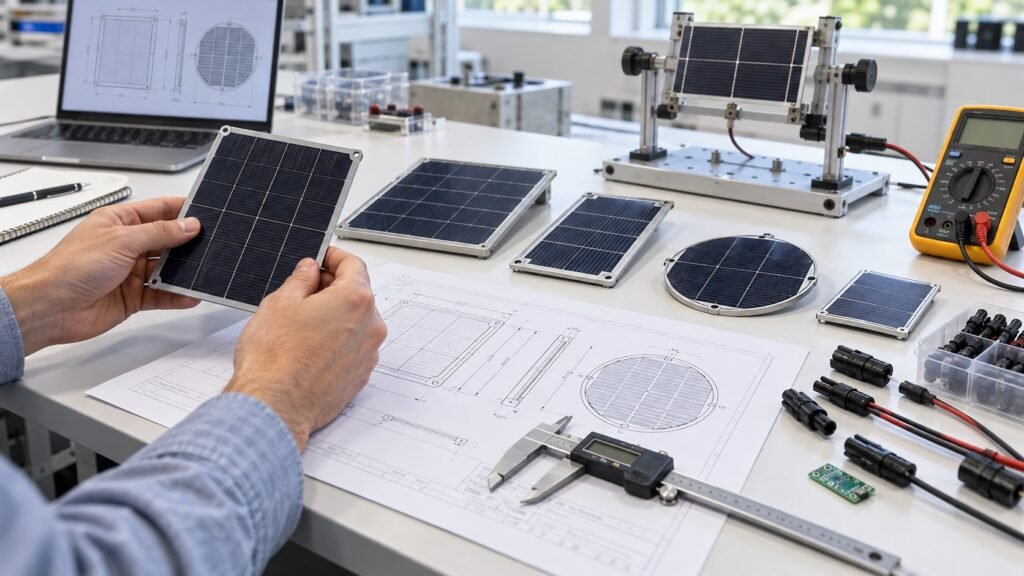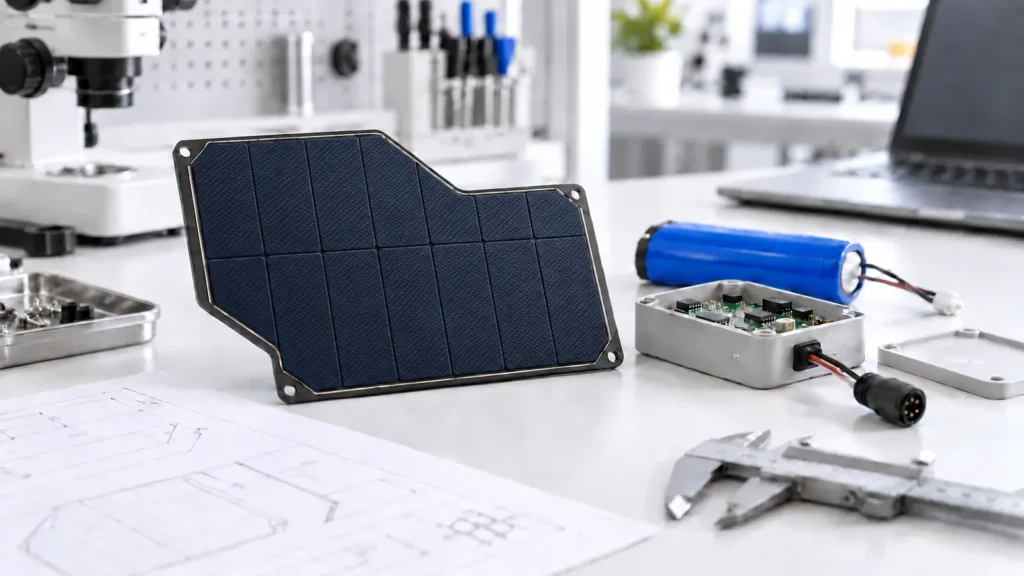
A useful custom solar panel RFQ gives the supplier enough information to evaluate the product as a complete system. A request containing only length, width, and wattage usually leaves important questions about voltage, light, battery charging, materials, mounting, and production unresolved.
This checklist helps OEM product teams prepare a clear request for quotation for a compact monocrystalline solar module.
1. Explain the Product and Use Case
Start with a short description of the finished product, what the solar module must accomplish, and who will install or use it. Identify whether solar is the primary energy source, a battery-life extender, a maintainer, or an emergency input.
State whether the product is an IoT sensor, tracker, camera, instrument, controller, light, marine accessory, vehicle device, or another type of hardware. The application gives context to every later specification.
2. Describe the Operating Environment
Identify indoor or outdoor use, fixed or mobile installation, expected sunlight, shading, temperature, humidity, water, dust, salt, vibration, impact, cleaning, and chemical exposure. Avoid vague descriptions such as “weatherproof” without defining the actual conditions or required test method.
Provide installation location, orientation, and seasonal constraints where known. For a mobile product, describe common positions and periods when the panel may be covered.
3. Provide a Dimensioned Drawing
Include maximum length, width, thickness, corner radii, holes, cutouts, active-area priority, cable exit, and keep-out zones. Identify which dimensions are critical and which can change during optimization.
An enclosure drawing or STEP model can help the supplier identify conflicts that are not obvious from a rectangular outline. If the industrial design is still flexible, state where the panel footprint may grow.
4. Share the Device Energy Budget
Provide measured energy for sleep, active, sensing, processing, communication, display, lighting, and actuator states. Include duty cycle, reporting interval, event frequency, peak current, and daily energy.
Datasheet values are useful early in development, but measurements from working hardware and production-intent firmware are more reliable. If the budget is still estimated, identify the uncertainty.
5. Identify the Battery and Charging Circuit
List battery chemistry, nominal voltage, capacity, series or parallel configuration, allowable charging voltage, and required autonomy. Provide the charging IC or PMIC model, schematic section, input range, maximum input voltage, and cold-start behavior.
This information allows the supplier to propose a module voltage rather than guessing from the battery label.
6. Define the Electrical Target
State the required Vmp, Imp, Voc, Isc, power, or daily energy target and the conditions under which it applies. If the supplier must recommend these values, make that request explicit and provide the charger and light information needed for the calculation.
Avoid treating cell efficiency as the only performance requirement. The product uses the finished module, so external dimensions, active area, spacing, optical losses, and cell configuration matter.
7. Select Cell and Module Construction
Identify whether monocrystalline silicon is required or whether the supplier may propose alternatives. State preferences for ETFE, PET, glass, backsheet, substrate, color, texture, rigidity, flexibility, and appearance.
If the material is not decided, provide the environment, weight, thickness, lifetime target, and cost priorities so the supplier can compare suitable constructions. The ETFE versus PET guide can help structure a lightweight-material review.
8. Specify Cable and Connector Requirements
Provide cable type, conductor size, length, color, exit direction, strain relief, connector manufacturer and part number, mating part, polarity, and any bare-wire termination. Mark the exit position on the drawing.
If the supplier may recommend a connector, describe current, voltage, environment, assembly method, user access, and replacement needs.
9. Define the Mounting Method
Explain whether the module will use adhesive, screws, clips, brackets, gaskets, pockets, stitching, or installation behind a window. Identify the housing material and surface finish.
For adhesive mounting, define temperature, moisture, curvature, installation pressure, and replacement strategy. For mechanical mounting, include fastener dimensions, edge clearance, and supporting structure.
10. State Appearance and Branding Requirements
Define acceptable cell color, busbar visibility, surface texture, border color, logo, labels, cable colors, and packaging. Use approved samples and photographs to supplement written criteria.
Do not assume terms such as “all black” mean the same appearance to every supplier. Identify which visible differences are acceptable.
11. Provide Validation Requirements
List the product-level tests required by the application, customer, or regulatory plan. These may include dimensional inspection, electrical measurement, adhesion, cable pull, vibration, bending, impact, temperature cycling, humidity, UV, water exposure, or charging tests.
Avoid asking the supplier to claim certifications or ratings that have not been tested on the relevant finished product. Agree on test conditions, sample size, pass criteria, and required reports.
12. Describe the Development and Production Plan
State prototype quantity, pilot quantity, expected annual volume, target sample date, product launch timing, packaging needs, delivery destination, and forecast variability.
Ask which design features require tooling, which materials have minimum purchase quantities, and how changes will be controlled. Request separate sample, tooling, test, and production quotations where appropriate.
13. Request the Right Supplier Deliverables
- Proposed module drawing and revision number
- Cell layout and active-area information
- Vmp, Imp, Voc, and Isc under defined conditions
- Material-stack description
- Cable and connector specification
- Prototype quotation and schedule
- Tooling or setup charges
- Production quotation and commercial assumptions
- Inspection plan and acceptance criteria
- Change-control process
Common RFQ Mistakes
- Requesting wattage without explaining available light
- Specifying battery voltage without the charging circuit
- Using outside dimensions as if they were all active area
- Leaving the cable exit and connector until after sampling
- Requesting “waterproof” without a test or assembly definition
- Comparing quotations based on different constructions
- Approving a sample without a controlled drawing
- Ignoring production volume and material availability
How to Compare Supplier Quotations
Normalize the proposals before comparing price. Confirm that each quotation uses the same external dimensions, electrical target, cell technology, material stack, cable, connector, mounting features, validation scope, quantity, packaging, and commercial terms.
A lower unit price may exclude tooling, testing, connectors, inspection, or packaging. It may also use a different active area or material. Compare technical risk and total project cost alongside price. The existing guide on how to choose a custom solar panel manufacturer provides a broader supplier-evaluation framework.
Frequently Asked Questions
Can I request a quotation before the design is final?
Yes, but identify which values are estimates and ask for an engineering review. Expect the quotation to change when the controlled specification is finalized.
Do I need to specify wattage and voltage?
If they are known, include them. Otherwise provide the energy budget, battery, charger, light, and area so the supplier can recommend an electrical target.
Should I send confidential product drawings?
Send only the information necessary for evaluation and follow your company’s confidentiality process. A simplified interface drawing may be sufficient initially.
How many prototypes should I order?
The quantity depends on fit checks, electrical testing, environmental validation, internal teams, and destructive tests. Build a test plan before deciding.
When should the production specification be frozen?
After representative samples pass the required product-level tests and all revisions are captured in the approved drawing and specification.
A Better RFQ Produces a Better Engineering Response
A clear RFQ lets suppliers identify feasibility, tradeoffs, cost drivers, and test needs before tooling or sampling. It also makes competing proposals easier to compare and reduces late changes.
Review SiborTech’s small custom solar panel capabilities and application examples. When the checklist is ready, submit your custom solar requirements for engineering review.