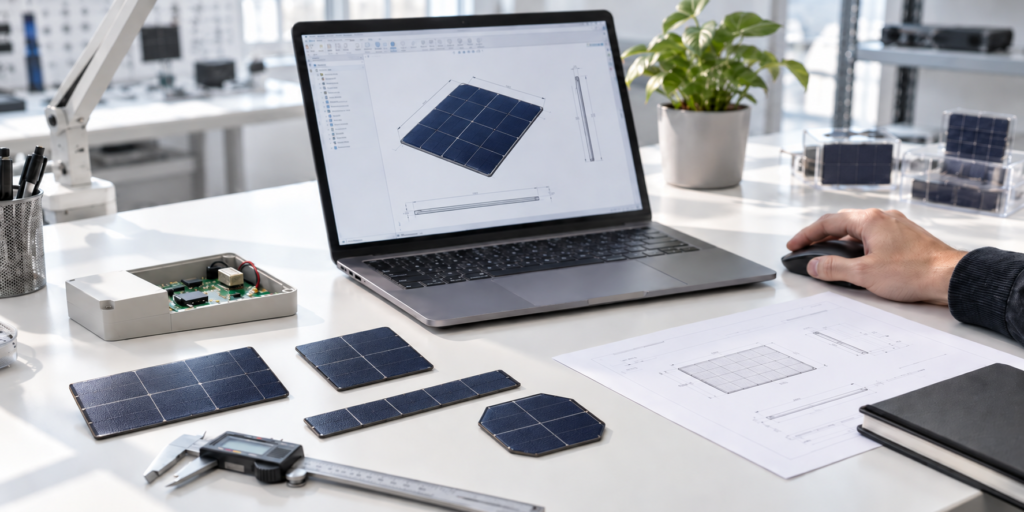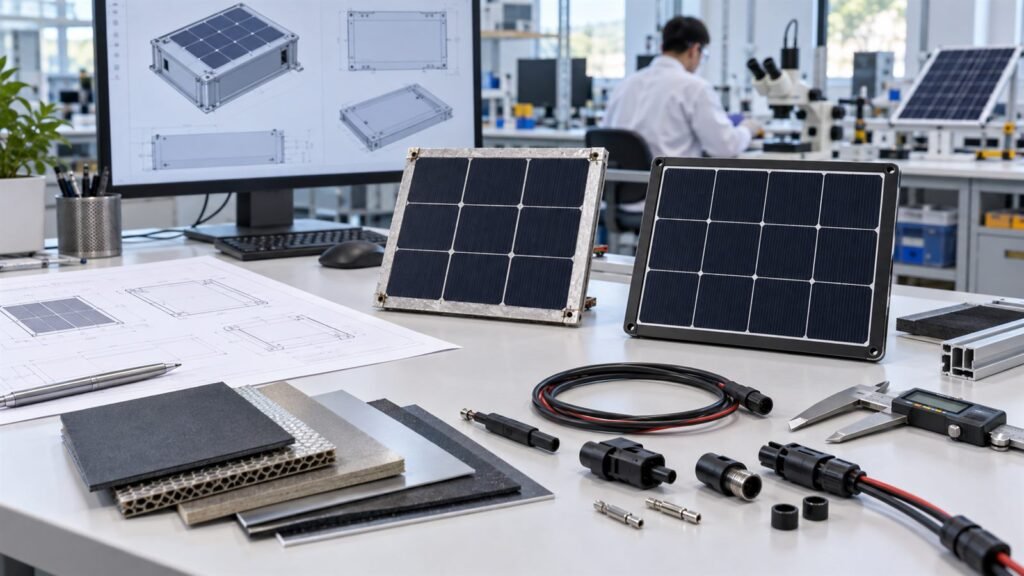
An approved solar-panel prototype proves a particular build can meet its test plan. It does not automatically prove that a factory can repeat that result across lots, operators and component purchases. Solar panel design transfer is the controlled handoff from development evidence to production instructions and acceptance records.
This article covers that handoff. The custom solar development process describes the wider project sequence, while the prototype testing guide focuses on sample approval. Transfer begins when the team must turn an approved configuration into a reproducible one.
Freeze the configuration that was actually approved
Identify the approved prototype by serial number, revision and test report. Collect its cell layout, laminate stack, encapsulant, backing, cable, connector, label and packaging details. Record any deviation from the drawing. A prototype built with an undocumented alternate adhesive should not become the production baseline by accident.
Create one controlled bill of materials and drawing set. Define critical dimensions, electrical limits and cosmetic boundary examples. If the panel is installed in a customer’s product, include the mating interface and keep-out areas. The transfer package should explain which requirements are measurable and which require an approved visual reference.
Convert tests into factory controls
Ask which prototype tests need to become routine production checks, which belong in periodic validation, and which are one-time design evidence. A light-source electrical check, polarity verification or connector fit check may be suitable for every unit. Environmental ageing or repeated-flex tests may be sampled or used after significant changes. The exact allocation depends on product risk and volume.
For each factory check, specify equipment, calibration, setup, conditions, limit, record and reaction to failure. A label reading “passed” without measured values and method will be hard to investigate later. Make lot or serial traceability link the finished product to its materials and process revision.
Run a pilot build with the intended process
Do not treat a hand-built engineering sample as a production trial. Use intended tools, fixtures, work instructions, operators and inspection points in a pilot lot. Record yield, recurring defects, cycle time and rework. Watch especially for cell alignment, cable routing, adhesive placement, edge sealing and packaging damage.
| Gate | Evidence required |
|---|---|
| Configuration release | Signed drawing, BOM and approved sample revision |
| Process readiness | Work instructions, fixtures and trained operators |
| Quality readiness | Test methods, limits, calibration and defect handling |
| Pilot review | Yield, deviations, corrective actions and customer decision |
Resolve the pilot’s open issues before calling the design transferred. If an improvement changes a controlled part or process, assess whether the prototype validation remains applicable.
Include a production representative in the review of any deviation. An assembly that passes electrical testing may still have an unstable cable route, inconsistent adhesive coverage or poor fit in the customer’s housing. Record the observed defect, containment, root cause, corrected instruction and retest result. This gives the next lot a controlled starting point instead of repeating a workshop fix.
Assign ownership of changes
Name who can approve a material substitution, connector change, process move or drawing update. Set the effective lot for each change and decide which tests must be repeated. The related custom solar panel prototype testing guide explains how qualification evidence supports inspection; it should be tied to the released revision, not used as an informal override.
Keep the customer’s decision visible
A transfer meeting should end with an explicit disposition: release, release with controlled open items, or hold. Share the configuration, acceptance plan, pilot evidence, traceability method and unresolved risks with procurement and the customer engineering team. This prevents commercial orders from referencing an older drawing while production follows a newer one.
If your custom module is moving toward volume production, send SiborTech the approved prototype records and expected production volume. A defined transfer package makes supplier review more concrete than a request to “copy the sample.”