A solar battery charger and a solar battery maintainer may use similar components, but they are not automatically the same product. The difference is mainly in the job the system is expected to perform, the battery condition it must support, and the way charging is controlled.
For OEM product teams, distributors, and equipment manufacturers, the distinction affects panel size, controller design, cable interface, battery compatibility, user instructions, and validation. It should be defined before selecting a panel or presenting the product to customers.
Solar Charger and Solar Maintainer: The Practical Difference
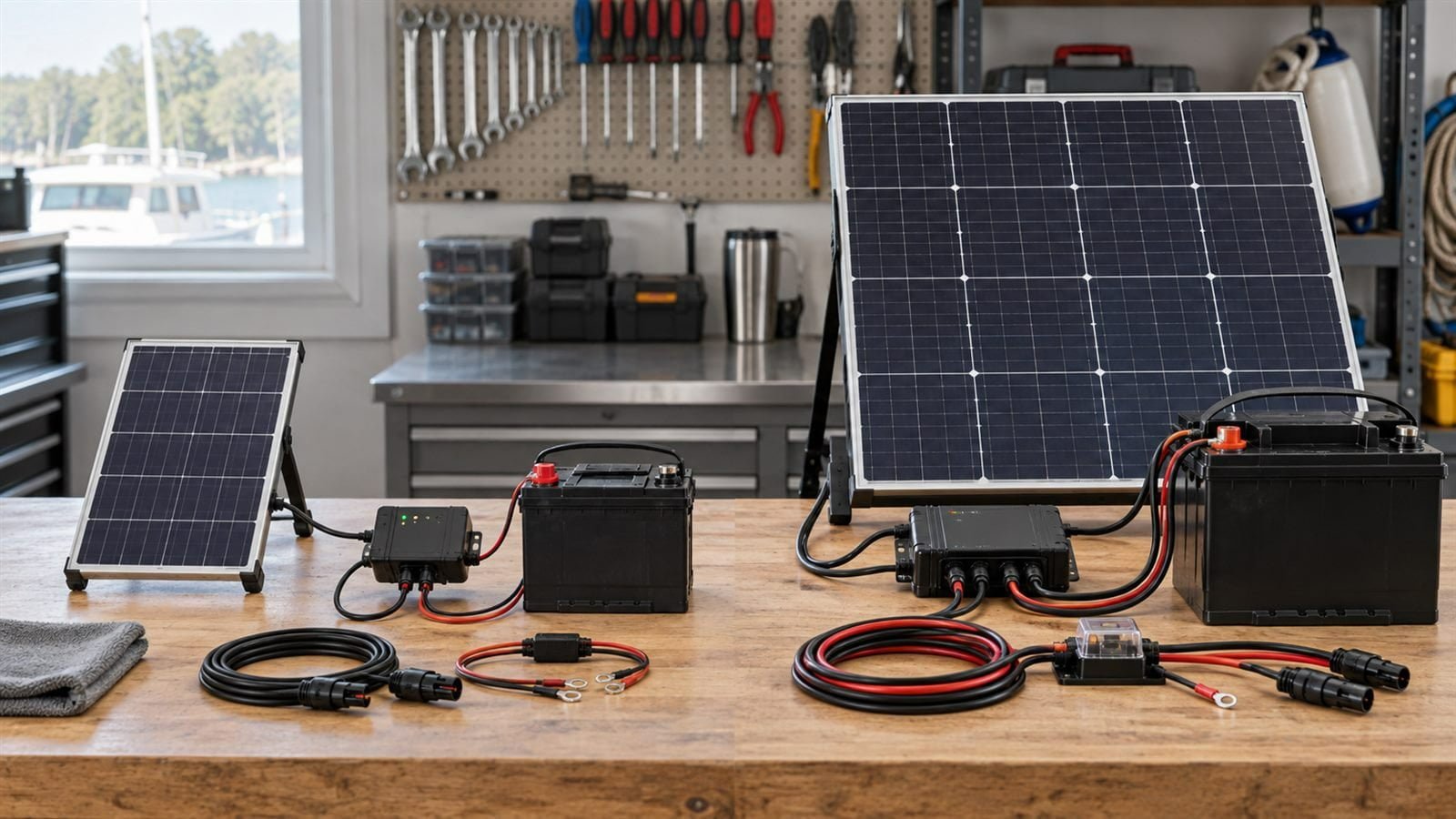
A solar battery charger is intended to add meaningful energy to a battery. It may support recovery after normal use, replenish energy consumed by equipment, or charge a battery during daylight operation.
A solar battery maintainer is normally intended to offset small standing losses while equipment is parked or stored. These losses can include battery self-discharge and low continuous loads from alarms, controllers, trackers, clocks, or monitoring electronics.
| Design question | Solar battery charger | Solar battery maintainer |
|---|---|---|
| Primary purpose | Replace energy after use or support active charging | Preserve battery condition during storage or low use |
| Typical battery state | Partly discharged or supporting an operating load | Already charged or near its intended storage condition |
| Energy demand | Usually higher and linked to a duty cycle or recovery target | Usually lower and linked to standing losses |
| Connection period | May be temporary, cyclic, or part of regular operation | Often intended for extended connection |
| Control requirement | Matched charge control and input limits are required | Long-term regulation and overcharge protection require careful review |
| Validation focus | Charging performance, recovery, temperature, and load operation | Long-duration behaviour, standby losses, storage conditions, and battery state |
A Maintainer Is Not a Battery Recovery Tool by Default
A low-power maintainer may be suitable for preserving a healthy stored battery, but it may take a long time to recover a significantly discharged battery. The connected equipment may also consume more energy than the small solar input provides.
Define the required outcome clearly:
- Offset self-discharge only
- Offset self-discharge plus known standby loads
- Recover energy used during periodic starts or tests
- Recharge after normal equipment operation
- Support a continuous electrical load
Those are different energy problems. A product described as a maintainer should not be presented as a full charger unless the system has been designed and validated for that role.
Expected Current Depends on the Application
Maintainers are generally associated with lower charging current than systems designed for active recovery. However, product names alone do not define a safe current or suitable panel size.
The required solar input depends on battery chemistry, capacity, standing load, storage period, available daylight, orientation, seasonal conditions, charging losses, and the controller. An equipment manufacturer should begin with measured losses and the required battery outcome rather than a generic current label.
Continuous Connection Changes the Control Requirement
A product intended to remain connected for weeks or months needs appropriate regulation for the battery and use case. The design must prevent the solar source from applying an unsuitable charging condition when the battery is already charged.
Depending on the architecture, this may require an integrated controller, a separate charge controller, or an equipment-side charging circuit. The required control depends on the battery chemistry, system voltage, charging profile, temperature conditions, and existing vehicle or equipment electronics.
Do not assume a small panel can be connected directly to every battery. Low panel power does not remove the need to confirm charging behaviour, reverse-current protection, polarity, voltage limits, and long-term connection.
Battery Chemistry Must Be Specified
Lead-acid and lithium-based batteries do not share one universal charging profile. Even within a battery family, construction, series configuration, protection electronics, and equipment requirements can differ.
For an OEM project, record:
- Battery chemistry and series configuration
- Nominal voltage and capacity
- Permitted charging voltage and current
- Existing battery-management or charging electronics
- Standing loads while the equipment is parked
- Expected storage temperature and daylight
- Connection point, polarity, cable, fuse, and connector requirements
Use the battery and equipment manufacturer’s approved charging information. Do not infer compatibility from a voltage label or connector alone.
Overcharge and Reverse-Current Protection Matter
Long-duration products should be reviewed for overcharge protection and for unwanted battery discharge when the panel is dark. The required protection may be built into the solar product, the vehicle or equipment, or a separate controller.
The system architecture should make that responsibility clear. If protection is external, product documentation should identify the required interface rather than implying that the panel assembly provides it.
Typical OEM Application Scenarios
Cars and stored vehicles
A maintainer may be considered where a parked vehicle has predictable standby loads and periodic access to daylight. The connection point and vehicle electronics must be reviewed.
RVs and camper equipment
An RV may need maintenance during storage or more active charging when appliances and control systems are in use. Those operating modes may require different panel and controller sizing.
Boats and marine equipment
Marine storage introduces mounting, cable routing, corrosion, shading, and environmental considerations. Battery banks and onboard charging systems must be identified before integration.
ATVs, tractors, and utility equipment
Seasonal equipment may sit unused between operating periods. A maintainer can be evaluated against storage duration, parasitic loads, vibration, connector access, and the actual battery system.
Backup and remote battery systems
A remote system may need to maintain readiness while also supporting monitoring electronics. If the load is continuous, the design becomes an energy-balance problem rather than simple storage maintenance.
How Product Teams Should Choose the Category
Use a maintainer position when the product’s validated role is to offset predictable storage losses and preserve battery condition. Use a charger position when the product is designed to replace a defined amount of energy after use or support a meaningful operating load.
Before finalising the product brief, answer:
- What battery and equipment will be connected?
- What state is the battery in when solar charging begins?
- What standing and periodic loads remain active?
- How much energy must be replaced and within what period?
- Can the product remain connected continuously?
- Where is charge control located?
- What protection and disconnection behaviour are required?
- What daylight and mounting conditions are realistic?
OEM Specification Checklist
| Area | Information to define |
|---|---|
| Product role | Maintenance, recovery, active charging, or load support |
| Battery | Chemistry, configuration, voltage range, capacity, and charging limits |
| Loads | Self-discharge assumptions and measured equipment standby demand |
| Solar input | Available area, orientation, shading, season, and expected exposure |
| Control | Controller location, charge profile, input limits, and reverse-current protection |
| Interface | Connection point, connector, polarity, cable, fuse, and strain relief |
| Environment | Storage temperature, moisture, vibration, mounting, and handling |
| Validation | Long-duration connection, recovery behaviour, temperature, and target equipment |
Common Product-Positioning Mistakes
Calling every low-power charger a trickle charger
The label does not define regulation, compatibility, or safe continuous connection.
Assuming a maintainer can recover any flat battery
Recovery depends on battery condition, controller behaviour, solar energy, connected loads, and time.
Sizing from battery voltage alone
Voltage does not describe the required energy or the complete charging interface.
Ignoring parked-equipment loads
An alarm, tracker, controller, or monitor can consume more than a small panel supplies under poor conditions.
Using connector fit as proof of compatibility
The electrical interface, polarity, protection, and charging method still need verification.
FAQ
Can a solar maintainer stay connected all the time?
Only when the complete system is designed and approved for continuous connection to the specified battery and equipment. Confirm charge control, protection, and environmental conditions.
Can a solar maintainer recharge a discharged battery?
It may add energy, but a low-power maintainer is not automatically suitable for timely recovery. Evaluate the battery state, connected loads, available solar energy, and controller.
Does every solar battery product need a controller?
The system needs an appropriate charging and protection architecture. Regulation may be integrated into the solar product, provided by the equipment, or supplied as a separate controller.
Is a larger solar panel always better?
No. Panel Vmp, Voc, current, energy, controller limits, mounting area, and battery requirements must be matched as a system.
Define the Charging Job Before Choosing the Hardware
The useful distinction is not the product label. It is whether the system must preserve a stored battery or replace a defined amount of energy. Once that job is clear, the panel, controller, cable, protection, and product documentation can be specified around the actual equipment.
Explore our solar battery charger and maintainer solutions and solar application examples. For an OEM battery-support product, discuss the target battery and equipment interface.