There is no useful universal price for a custom solar panel. Two modules with similar outer dimensions can have different cell layouts, materials, cables, tolerances, test requirements, and production assumptions.
The better question is: which parts of the specification are driving the quotation? Understanding those factors helps a buyer compare proposals without removing features the product actually needs.
Why Custom Solar Panel Prices Vary
A standard catalog panel spreads its development and setup costs across an established product. A custom module may require engineering review, a new layout, sample materials, tooling or fixtures, prototype work, and project-specific inspection.
The final unit cost is only one part of the commercial picture. A quotation may also include non-recurring engineering, tooling, prototype charges, testing, packaging, or special sourcing. Suppliers may group these items differently, so the total scope must be compared before the price is compared.
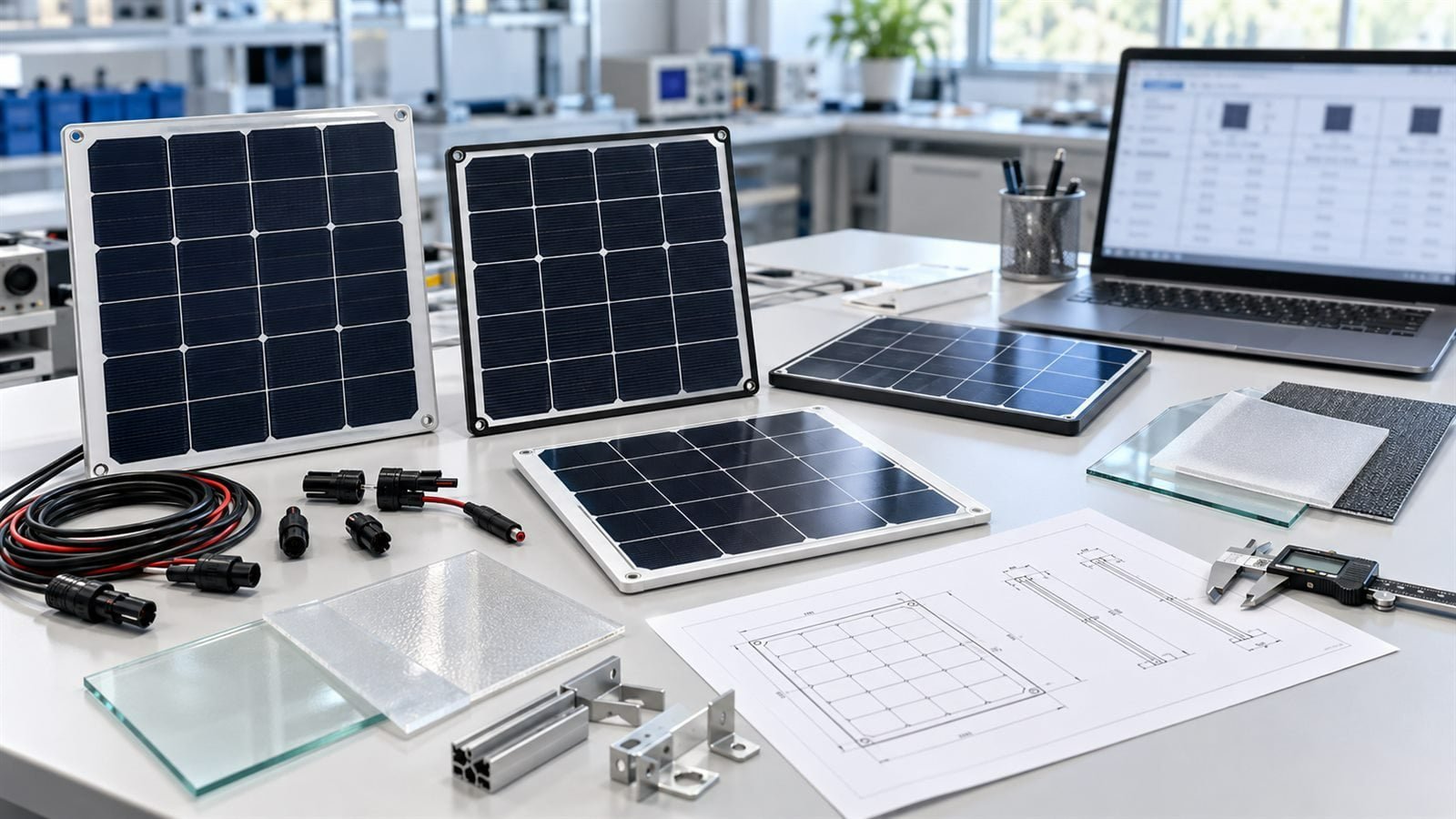
For a compact OEM product, the quotation should be tied to the complete small custom solar panel specification rather than area or nominal wattage alone.
1. Panel Dimensions and Shape
Outer dimensions affect material use, process setup, and how efficiently cells can be arranged. A simple rectangle is usually easier to lay out than an irregular outline with notches, holes, narrow sections, or tight corner radii.
Shape can also reduce usable active area. If a design wastes a large portion of a cell or needs many small pieces, the cost impact may be greater than the change in overall area suggests.
Before requesting a quote, provide a controlled drawing with:
- Overall length and width
- Tolerances
- Corner radii
- Holes and keep-out zones
- Cable exit position
- Mounting features
- Cosmetic boundaries
An accurate drawing lets the supplier evaluate a real layout instead of adding risk for an undefined shape.
2. Electrical Requirements
Voltage and current targets influence the cell arrangement and interconnection. A panel designed around one charging circuit may not be interchangeable with a panel for another circuit, even when both are intended for the same battery voltage.
The quotation request should distinguish:
- Target operating voltage
- Open-circuit voltage requirement or limit
- Target operating current or power under a defined test condition
- Charge-controller or PMIC input limits
- Series or parallel connection needs
- Polarity and protection requirements
Tight electrical tolerances or unusual configurations may need additional selection, process control, or testing. Avoid specifying a tighter limit than the product needs.
3. Solar Cell Use and Layout Efficiency
The physical outline and electrical target meet in the cell layout. Usable cell area, cut pattern, interconnects, inactive margins, and expected shading all affect the design.
A layout that uses cells efficiently can reduce waste. A highly constrained design may require smaller cell pieces, more interconnect work, or a compromise between appearance and electrical output.
This is one reason cost cannot be estimated accurately from square centimetres alone.
4. Surface and Backing Materials
The module construction must match the product. Our current product range includes options such as ETFE, PET, glass, and other project-dependent constructions for small custom modules.
Material selection can affect:
- Rigidity or flexibility
- Thickness and weight
- Surface appearance and texture
- Lamination process
- Edge construction
- Mounting method
- Handling and cleaning
- Environmental validation
The lowest-cost surface is not always the lowest-cost product decision. A material that does not suit the mounting method or environment can create redesign, field, or warranty risk.
Claims about weather resistance, lifetime, or ingress protection should be tied to the exact construction and verified test evidence. A material name by itself is not proof of a rating.
5. Cable and Connector Assembly
A cable assembly can be a meaningful part of a small module’s cost. The quote may change with:
- Cable type and conductor size
- Cable length
- Connector family and source
- Custom pinout
- Polarity marking
- Strain relief
- Junction or exit design
- Sealing requirement
- Additional adapters or branch cables
A common connector may be straightforward. A proprietary mating interface, short procurement run, or custom overmould can require added sourcing or tooling.
Give the supplier the exact mating connector or approved part number when possible. A photograph is helpful, but it does not define pinout or electrical rating.
6. Prototype and Engineering Work
Prototype cost reflects the work needed to convert requirements into a reviewable sample. It may include layout, drawing preparation, material setup, manual processes, fixture creation, and engineering communication.
A first sample is often more expensive per unit than production because the work is spread across very few pieces. That does not mean the production price will follow the same ratio.
Clear inputs can reduce avoidable iteration. Useful inputs include an enclosure drawing, load profile, charging-circuit data, material preference, connector details, and a prototype test plan.
7. Tooling, Fixtures, and Non-Recurring Charges
Some designs need dedicated tooling, cutting dies, printing screens, test fixtures, or assembly aids. Other projects can be prototyped with flexible processes and need little dedicated tooling.
Ask each supplier to separate:
- Engineering or setup charges
- Tooling and fixture charges
- Prototype unit charges
- Production unit price
- Testing or documentation charges
- Packaging development
Also ask who owns project-specific tooling, how long it is retained, and what happens if the design changes. These are commercial terms that should be reviewed and written into the agreement.
8. Testing and Acceptance Requirements
Every product needs appropriate checks, but test scope should follow risk. A panel embedded in a protected indoor device does not necessarily need the same validation as a panel mounted on mobile outdoor equipment.
Cost can be affected by:
- Electrical test conditions
- Dimensional inspection
- Cosmetic inspection
- Cable pull or strain checks
- Mounting trials
- Environmental tests
- Sample size and reporting
- Third-party laboratory work
- Traceability and retained samples
Do not add a certification name only because it sounds reassuring. Confirm whether the finished product, component, market, or customer requirement actually calls for that certification or test.
9. Order Quantity and Production Assumptions
Quantity changes how setup, purchasing, inspection, and handling costs are distributed. A prototype batch, pilot run, and repeat production order should not be expected to carry the same unit price.
Volume also affects material purchasing. A connector, film, backing, or packaging component may have its own supplier minimum. If the requested order is below that minimum, the quote may include unused material or a higher component price.
Share a realistic forecast with separate numbers for prototypes, initial production, and expected repeat orders. An inflated forecast may produce a price that cannot be maintained when the actual order arrives.
10. Packaging, Labelling, and Branding
OEM projects may need labels, serial or lot information, retail packaging, accessories, instructions, or branded carrying materials. These items can be outside the module price unless the request defines them.
For a clean comparison, state whether the quote should include:
- Individual protective packaging
- Retail packaging
- Printed labels or laser marking
- Manuals and inserts
- Cables and adapters
- Carton requirements
- Pallet or shipment constraints
How to Compare Two Custom Solar Panel Quotations
Use a scope table rather than comparing the final number alone.
| Item | Questions to ask |
|---|---|
| Drawing | Are dimensions, tolerance, and revision identical? |
| Electrical target | Are ratings based on the same test conditions? |
| Construction | Are surface, backing, thickness, and edge design the same? |
| Cable | Are length, wire, connector, pinout, and strain relief included? |
| Prototype | How many units and revision rounds are included? |
| Tooling | What is included, who owns it, and when is it charged again? |
| Testing | Which checks, sample sizes, and reports are included? |
| Quantity | Is the price tied to the same order quantity and forecast? |
| Packaging | Is the same packaging and accessory scope included? |
| Change control | What happens if a material or component changes? |
If one quote is much lower, look for a missing assumption before treating it as an efficiency advantage.
Ways to Control Cost Without Weakening the Product
Define must-have and preferred requirements
A hard thickness limit is different from a preferred target. Labelling priorities gives the supplier room to offer a practical design.
Simplify the outline where possible
Small geometry changes may improve cell use or process yield. Ask for a manufacturability review before freezing the enclosure.
Use an available connector when it meets the interface
A custom connector or overmould may be justified, but it should solve a clear product need.
Match test scope to risk
Use conditions should drive validation. Avoid both under-testing and a copied test list with no link to the application.
Stabilise the surrounding product before production tooling
Changes to the enclosure, charger, or cable route can force panel revisions. Coordinate interface decisions before design freeze.
FAQ
Can a custom solar panel price be estimated from dimensions alone?
Only as a rough early indication. A usable quotation also needs electrical targets, construction, cable and connector details, quantity, and test expectations.
Why are prototype units more expensive?
Engineering, setup, sourcing, and manual work are spread over a small quantity. Production pricing should be evaluated separately.
Does a higher wattage always make the panel more expensive?
Not by itself. Wattage interacts with area, cell layout, construction, and test conditions. Compare the complete specification.
Should I request the lowest possible tolerance?
Request the tolerance the product needs. Unnecessarily tight limits can add inspection or process cost without improving function.
What should I send for a firm quotation?
Send a drawing, electrical requirements, charging interface, materials, cable and connector details, environment, test expectations, prototype quantity, and production forecast.
Next Step
We can review a custom panel requirement based on its dimensions, shape, voltage, current, connector, materials, and intended application. Share your panel requirements so the technical questions can be identified before a production-oriented quotation is prepared.