Indoor solar energy harvesting allows low-power electronic devices to convert ambient light into electrical energy. For IoT products such as wireless sensors, electronic shelf labels, smart-building devices, and asset monitors, indoor photovoltaic cells can help reduce battery replacement frequency or extend maintenance intervals when the energy budget and light environment are suitable.
Indoor solar is not a miniature version of an outdoor solar system. Light intensity is far lower, lamp spectra vary, and the available panel area is often small. Successful integration therefore requires careful coordination between the photovoltaic module, power-management circuit, battery or capacitor, firmware, enclosure, and installation environment.
How Indoor Solar Energy Harvesting Works
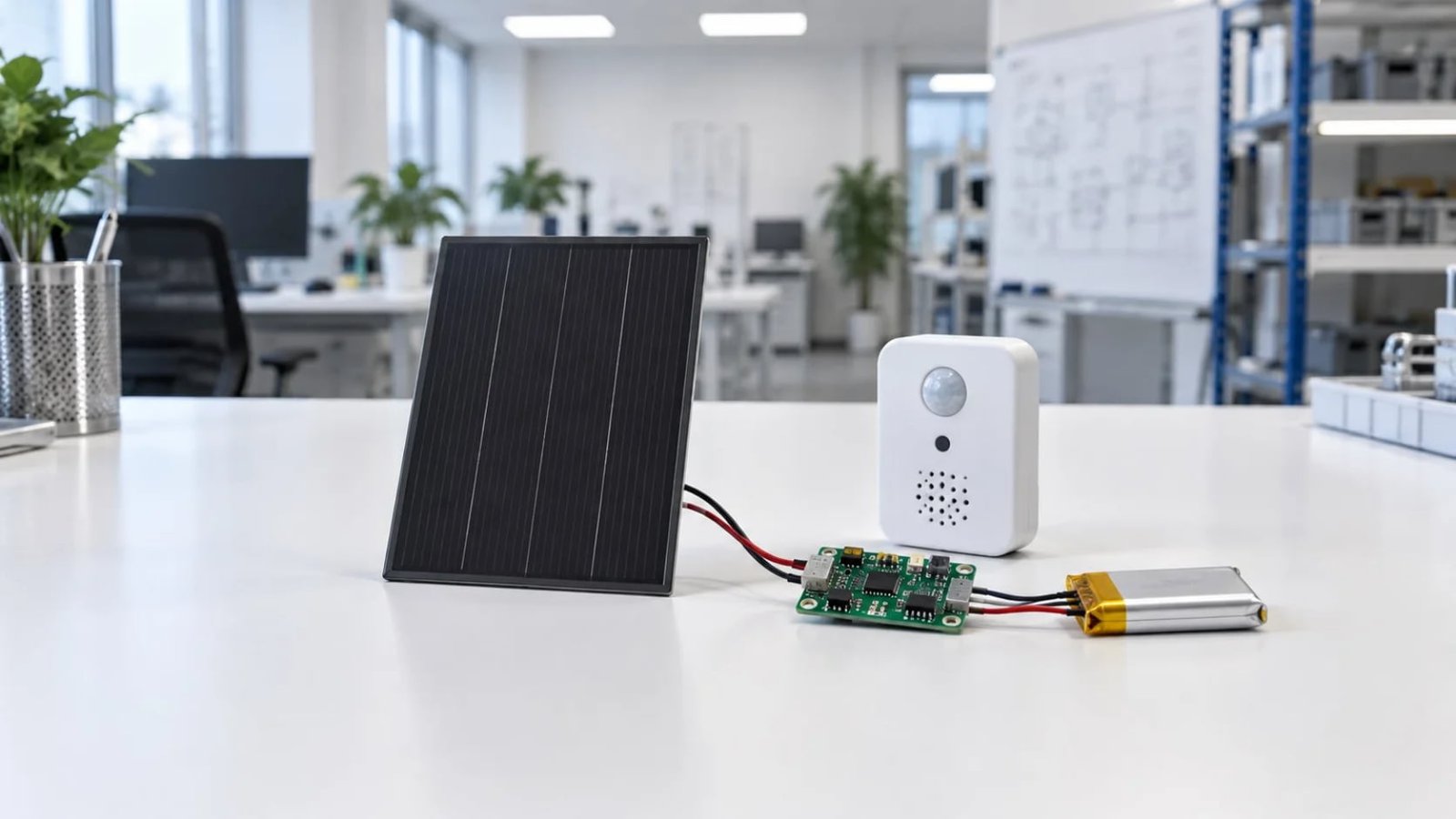
An indoor photovoltaic module generates electricity from artificial light or indirect daylight. A power-management circuit collects this energy and stores it in a rechargeable battery or supercapacitor. The stored energy then powers the device during operation and when the light is off.
The basic power chain is:
Indoor PV Module → Energy-Harvesting Circuit → Storage Device → IoT Load
The goal is usually not continuous direct operation from the panel. Instead, the system accumulates small amounts of energy over time and uses that energy efficiently.
Why Outdoor Solar Ratings Do Not Work Indoors
Outdoor solar modules are commonly characterized under strong standardized illumination. Measure illuminance at the intended device position across the actual lighting schedule. Do not use an assumed office-lighting level to predict electrical output.
Artificial light also has a different spectrum. LEDs, fluorescent lamps, and filtered daylight interact differently with photovoltaic materials. Two locations with the same lux reading may not produce exactly the same electrical output if their light spectra differ.
For this reason, indoor PV modules should be evaluated under the expected lamp type, illuminance, temperature, distance, and installation angle.
Common Indoor IoT Applications
- Electronic shelf labels and smart retail displays
- Temperature, humidity, occupancy, and air-quality sensors
- Building automation nodes
- Smart locks and access-control accessories
- Remote controls and human-interface devices
- Warehouse tags and asset-monitoring devices
- Low-power beacons
- Consumer electronics with standby operation
The best candidates have very low sleep current, short active periods, efficient wireless communication, and access to reasonably predictable light.
Step 1: Build an Accurate Energy Budget
Measure energy consumption across all device states. Include sleep, sensing, processing, radio startup, data transmission, display updates, indicators, and power-management standby current.
Daily load energy = Sum of power in each state × time in that state
Include standby current in the energy budget. Its contribution depends on operating voltage, time in standby, and the energy available from the selected module under the measured lighting conditions.
Firmware choices—such as reporting interval, display refresh rate, retry behavior, and connection protocol—can determine whether the energy budget closes. For a broader outdoor and indoor calculation workflow, see how to size a solar panel for an IoT device.
Step 2: Characterize the Installation Light
Do not rely on a general statement such as “office lighting.” Measure or define:
- Typical and minimum illuminance at the device
- Lamp type and spectrum
- Hours of light per day
- Weekend and holiday schedules
- Distance and angle from the light source
- Shadows from shelves, furniture, users, or product packaging
- Daylight contribution and seasonal variation
For retail products, test the actual shelf position. Light measured in the aisle may be much higher than light reaching the device face.
Step 3: Select the Photovoltaic Technology
Indoor PV technologies can include amorphous silicon and emerging thin-film options such as perovskite-based devices. Depending on enclosure geometry, the product may use a custom rigid perovskite solar panel or a custom flexible perovskite solar panel. The best choice depends on measured low-light output, available area, voltage requirement, appearance, flexibility, lifetime target, cost, and production maturity.
A technology that performs well in sunlight is not automatically optimized for LED lighting. Compare power density under the target spectrum and illuminance, not only outdoor efficiency.
For visible consumer products, color and appearance may also matter. Indoor modules can become part of the industrial design rather than an add-on component.
Step 4: Match Voltage to the Energy-Harvesting Circuit
Low-light photovoltaic sources have limited current and a voltage that changes with light conditions and load. The energy-harvesting IC should operate efficiently at the source’s expected voltage and power range.
Review cold-start voltage, minimum input power, maximum power point behavior, quiescent current, charging efficiency, storage-device compatibility, and output regulation.
Cold start is especially important. A circuit may run efficiently after startup but fail to begin operation from a deeply discharged state under weak light.
Step 5: Choose the Right Energy Storage
A rechargeable battery or supercapacitor allows the device to operate during darkness and supply current peaks that the PV module cannot provide directly.
Selection factors include required dark-time autonomy, peak current, cycle life, leakage, self-discharge, temperature range, size, safety, and charging-voltage limits.
Storage capacity should cover nights, weekends, shipping, low-light periods, and unusual communication activity. At the same time, an oversized storage device may take too long to recover after deep discharge.
Step 6: Optimize the Device for Intermittent Energy
Energy-harvesting products perform best when firmware adapts to available energy. Possible strategies include:
- Longer sleep periods during low energy
- Reduced transmission frequency
- Batching sensor data
- Shorter radio-on time
- Using event-driven rather than continuous sensing
- Disabling nonessential indicators
- Storing energy before high-power tasks
- Monitoring storage voltage and changing operating mode
This approach may make a smaller photovoltaic area practical, provided the required core functions still meet the product’s operating and reliability targets.
Step 7: Integrate the Module Into the Enclosure
Mechanical design affects harvested energy. A dark decorative cover, tinted window, printing, adhesive layer, or recessed mounting position can reduce useful light.
Define the visible active area, module dimensions, thickness, shape, electrical contacts, mounting method, and orientation early. Test the PV module behind the exact cover material planned for production.
For flexible indoor modules, also define the minimum bend radius and whether bending occurs only during assembly or throughout the product’s life.
Step 8: Test Worst-Case Conditions
A short bench test under a bright desk lamp can create unrealistic confidence. Validation should include minimum expected illuminance, the real lamp spectrum, unfavorable angle, reduced lighting hours, full dark periods, aged storage performance, and device communication retries.
Track energy harvested, device energy consumed, storage voltage, cold-start behavior, and recovery time. A stable design should avoid a gradual energy deficit across repeated daily cycles.
Indoor Solar for Electronic Shelf Labels
Electronic shelf labels are a strong use case because they can spend long periods in low-power standby and update only when required. Indoor PV can support longer battery life or, in carefully optimized designs, reduce dependence on disposable batteries.
However, shelf position, store lighting schedules, label orientation, display update energy, and wireless network behavior must all be included in the design. One panel size may not suit every shelf location.
Indoor Solar for Smart Sensors
Temperature, humidity, occupancy, and air-quality sensors can also benefit from ambient-light harvesting. Their feasibility depends on sensing frequency, sensor warm-up time, radio protocol, display requirements, and available light.
Devices placed near ceilings or windows may receive more light than sensors hidden behind furniture or installed in corridors with motion-controlled lighting. Site assumptions should be explicit.
Information to Share With an Indoor PV Supplier
- Maximum module dimensions and visible area
- Target shape, color, rigidity, or flexibility
- Measured daily device energy
- Peak current and operating voltage
- Energy-harvesting IC and storage device
- Minimum and typical illuminance
- Lamp type and hours of operation
- Enclosure cover material and optical transmission
- Required dark-time autonomy
- Prototype quantity and production forecast
Frequently Asked Questions
Can indoor solar eliminate batteries?
Sometimes, but many products still need a rechargeable battery or capacitor to handle darkness and current peaks. The result depends on energy budget and light availability.
Does lux tell me how much power the panel will produce?
Lux is useful but not sufficient. Spectrum, module technology, angle, and electrical operating point also affect output.
Can I use a normal outdoor solar panel indoors?
It may generate some power, but it may not provide the best power density or voltage behavior under artificial light.
Are perovskite solar cells suitable for indoor IoT?
Perovskite-based modules are being developed for indoor low-light operation, but suitability cannot be inferred from research results alone. Review module-level output under the target lamp, encapsulation, stability evidence, and production status for the proposed product.
How large should the indoor PV module be?
Size depends on measured device energy, power density under the target light, conversion losses, lighting hours, and the required design margin.
Design for the Whole Energy System
Indoor solar energy harvesting works best when photovoltaic output, electronics, storage, firmware, and product design are developed together. Begin with real measurements, design for the minimum expected light, and validate repeated day-and-night operation before volume production.
Review our indoor IoT application scenarios, then share the module area, measured device energy, lamp conditions, storage configuration, and enclosure constraints. Discuss a custom indoor PV module with the engineering team before prototyping.