ETFE and glass can both protect monocrystalline solar cells, but they create very different modules. ETFE is commonly used in thin, lightweight laminates. Glass is used when rigidity, surface hardness, and a stable flat construction are more important than minimum weight.
The right choice depends on the finished product’s environment, mounting method, mechanical loads, appearance, service life target, and validation plan.
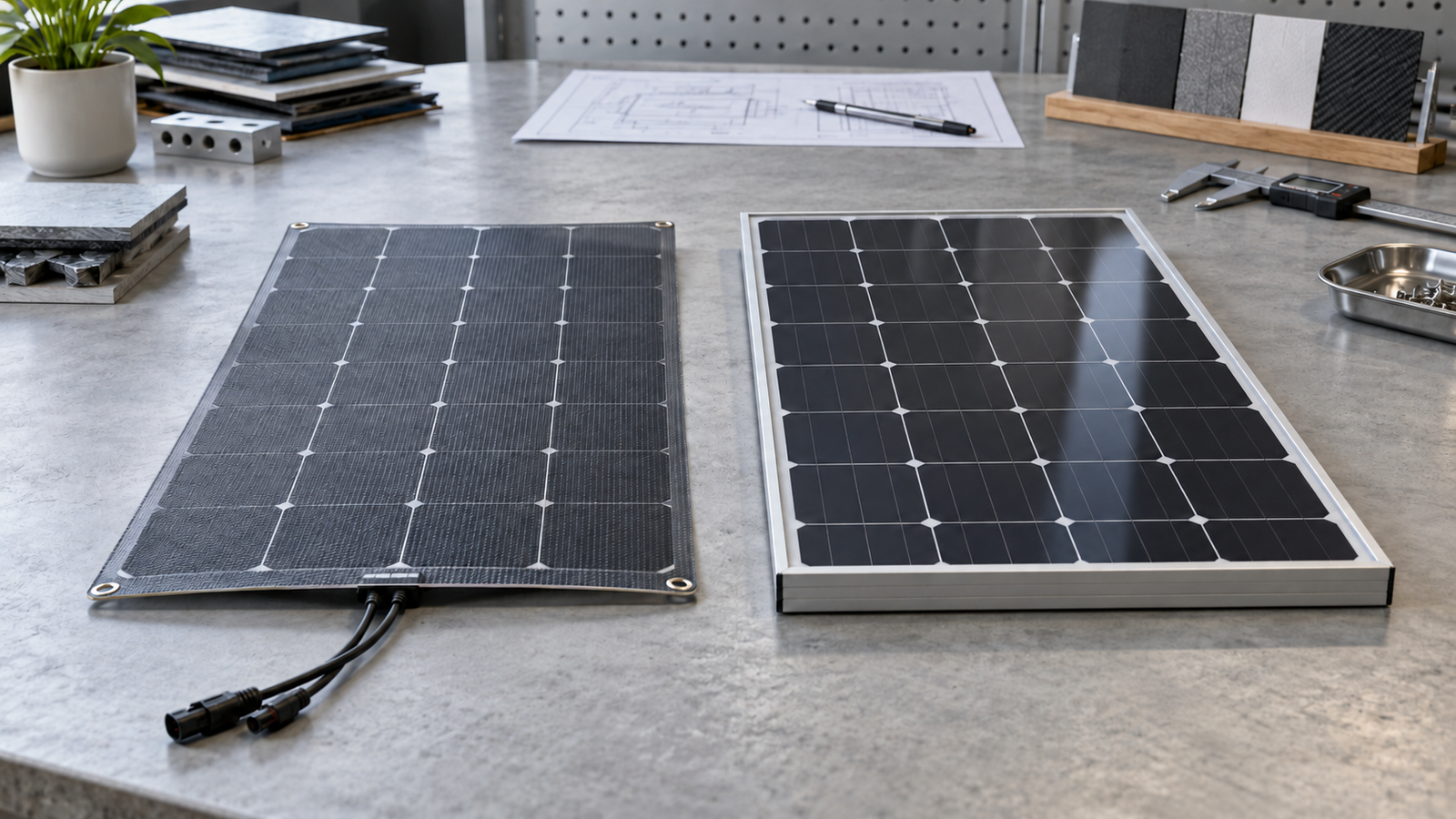
Compare Complete Module Constructions
ETFE and glass are front surfaces, not complete specifications. The encapsulant, cell assembly, backsheet or substrate, adhesive, edge treatment, cable exit, and manufacturing process all affect the result.
When comparing samples, use the same external dimensions, cell technology, electrical configuration, and test conditions. Otherwise, a difference attributed to the front material may actually come from active area or cell layout.
What Is an ETFE Solar Laminate?
ETFE is a fluoropolymer used as a lightweight outer layer in compact solar laminates. It is often paired with monocrystalline cells where a product needs a thin profile, low mass, and an outdoor-oriented surface.
ETFE modules may have a textured appearance and can be built on flexible or semi-rigid backing structures. The permissible bend depends on the entire stack and the cells, not the ETFE film alone.
What Is a Glass Solar Module?
A glass-front module uses a rigid transparent cover to protect the cells and provide a stable surface. Small custom glass modules can suit fixed sensors, instruments, outdoor housings, and visible electronics where thickness and weight are acceptable.
Glass type, thickness, edge finish, tempering or strengthening process, encapsulation, and supporting structure must be confirmed for the application. A small glass module should not inherit impact or safety assumptions from an unrelated rooftop product.
Weight and Thickness
ETFE laminates generally offer the clearest advantage when the product has a strict weight or thickness limit. They can be bonded to an enclosure or supported by a thin substrate.
Glass adds mass and thickness but may simplify flat mounting and give the module a more rigid feel. Product teams should compare the complete installed assembly, including backing plates, adhesives, brackets, and protective frames.
Rigidity and Dimensional Stability
Glass provides a naturally rigid plane. This can protect cell alignment and simplify integration into a fixed frame or recessed opening. It may also maintain a consistent visual surface across a larger opening.
An ETFE laminate follows its substrate. If it is bonded to an uneven housing, local stress or visible distortion may occur. Define flatness, curvature, and adhesive application during development.
Impact, Abrasion, and Handling
The two constructions respond differently to mechanical loads. Glass can provide good surface hardness but may chip or break under unsuitable impact or edge loading. ETFE avoids brittle glass breakage and is lighter, but its surface and laminate still require abrasion and handling evaluation.
Test the installed module against the product’s real risks: drops, tools, packaging, cleaning, vibration, flexing, hail-like impact, transport, or repeated user contact. Material labels cannot replace product-level testing.
Outdoor Exposure
ETFE is frequently selected for lightweight outdoor applications, while glass is widely used where a rigid transparent barrier is acceptable. Outdoor readiness still depends on edge sealing, encapsulant, backsheet, cable entry, mounting, and drainage.
Do not claim a water-ingress rating from the front surface alone. Any rating must apply to the tested final assembly. Review UV, humidity, thermal cycling, water exposure, salt, chemicals, and cleaning agents according to the deployment environment.
Appearance and Optical Behavior
ETFE often has a textured or matte technical appearance. Glass can provide a smooth, reflective surface. Coatings, texture, cell color, busbars, and internal spacing influence the final look.
Approve physical samples under the lighting in which customers will see the product. Reflections that seem minor on a workbench may affect camera housings, signage, or consumer-facing devices.
Curved and Irregular Surfaces
ETFE laminates are better suited to products that require low weight or a gentle fixed curve. This does not mean the panel can be repeatedly folded. Monocrystalline cells remain mechanically sensitive, and the interconnections need a defined strain limit.
Glass is generally used on flat or separately supported surfaces. If the housing is curved, consider whether a smaller flat glass module, a segmented arrangement, or a semi-flexible solar panel creates the lowest integration risk.
Mounting and Repair
An ETFE laminate may be bonded directly to the housing with a selected adhesive. Replacement can be difficult if the adhesive is permanent. Glass modules can be bonded, clipped, gasketed, or mechanically retained, which may support replacement but adds parts and space.
Define service strategy early. For inaccessible remote products, environmental reliability may matter more than ease of replacement. For serviceable equipment, a removable module and connector may reduce lifecycle cost.
Cost Should Be Compared at Assembly Level
Material price is only one component. Include backing support, framing, adhesive, gasket, installation labor, packaging, breakage risk, qualification testing, and field service.
A lightweight ETFE laminate can reduce structure and shipping weight, while a glass module may reduce the need for a separate rigid support. The better value depends on the final assembly.
Selection Guide
ETFE may be the better starting point when:
- Low weight and thin construction are priorities.
- The module must follow a gentle fixed curve.
- Direct bonding to a lightweight housing is preferred.
- A textured technical appearance is acceptable.
- The product is portable or vibration-sensitive.
Glass may be the better starting point when:
- A rigid, flat surface is required.
- Surface hardness and dimensional stability are priorities.
- The product can support additional weight and thickness.
- The module will be retained in a frame, recess, or gasket.
- A smooth glass appearance suits the industrial design.
Prototype Test Checklist
- Electrical output and charging behavior
- Dimensional fit, flatness, and cable routing
- Adhesive or mechanical retention
- Impact, vibration, and installation handling
- Abrasion and cleaning
- Temperature and humidity cycling
- UV and outdoor exposure as applicable
- Water-related testing of the complete assembly
- Appearance under real viewing conditions
Frequently Asked Questions
Is ETFE more flexible than glass?
Yes, but the finished panel’s flexibility is limited by its backing, solar cells, interconnections, and encapsulation.
Is a glass panel automatically more durable?
No. It may provide surface hardness and rigidity, but impact, edge loading, mounting, sealing, and environment must be evaluated.
Can ETFE be used outdoors?
ETFE is commonly selected for outdoor laminates, provided the complete construction and sealing are designed and tested for the application.
Which option produces more power?
Power depends on cell technology, active area, optical transmission, layout, and test conditions. Compare finished samples of equal size.
Can glass and ETFE use the same monocrystalline cells?
They may use comparable cells, but the manufacturing process and module design must be validated for each construction.
Select the Construction Around the Product
ETFE is a practical choice for thin, lightweight modules, while glass supports rigid and visually stable assemblies. The decision should follow mechanical integration and environmental requirements rather than a general material ranking.
Compare SiborTech’s custom small solar panel options and the existing ETFE versus PET guide. For an application-specific material review, discuss your project with the engineering team.