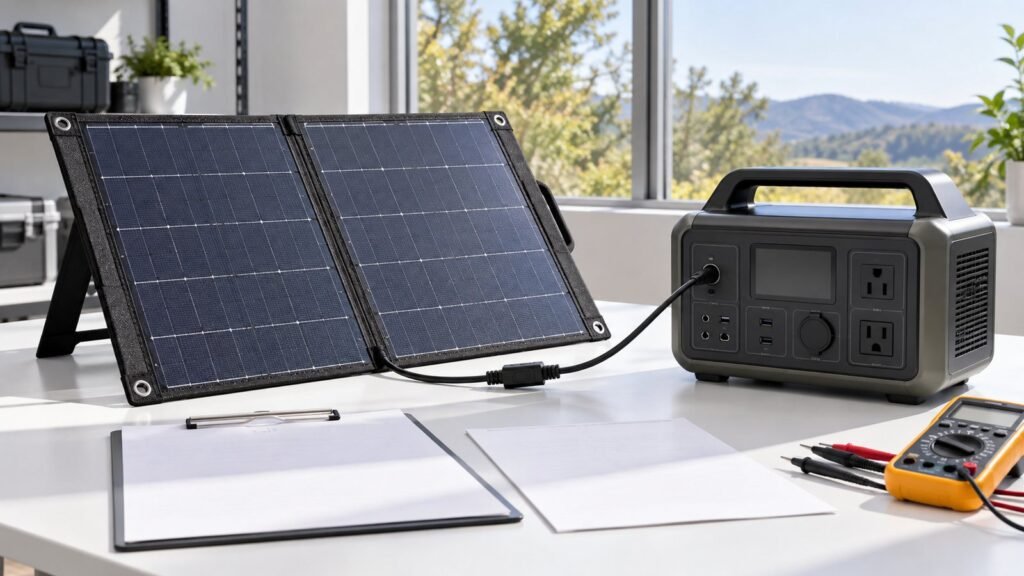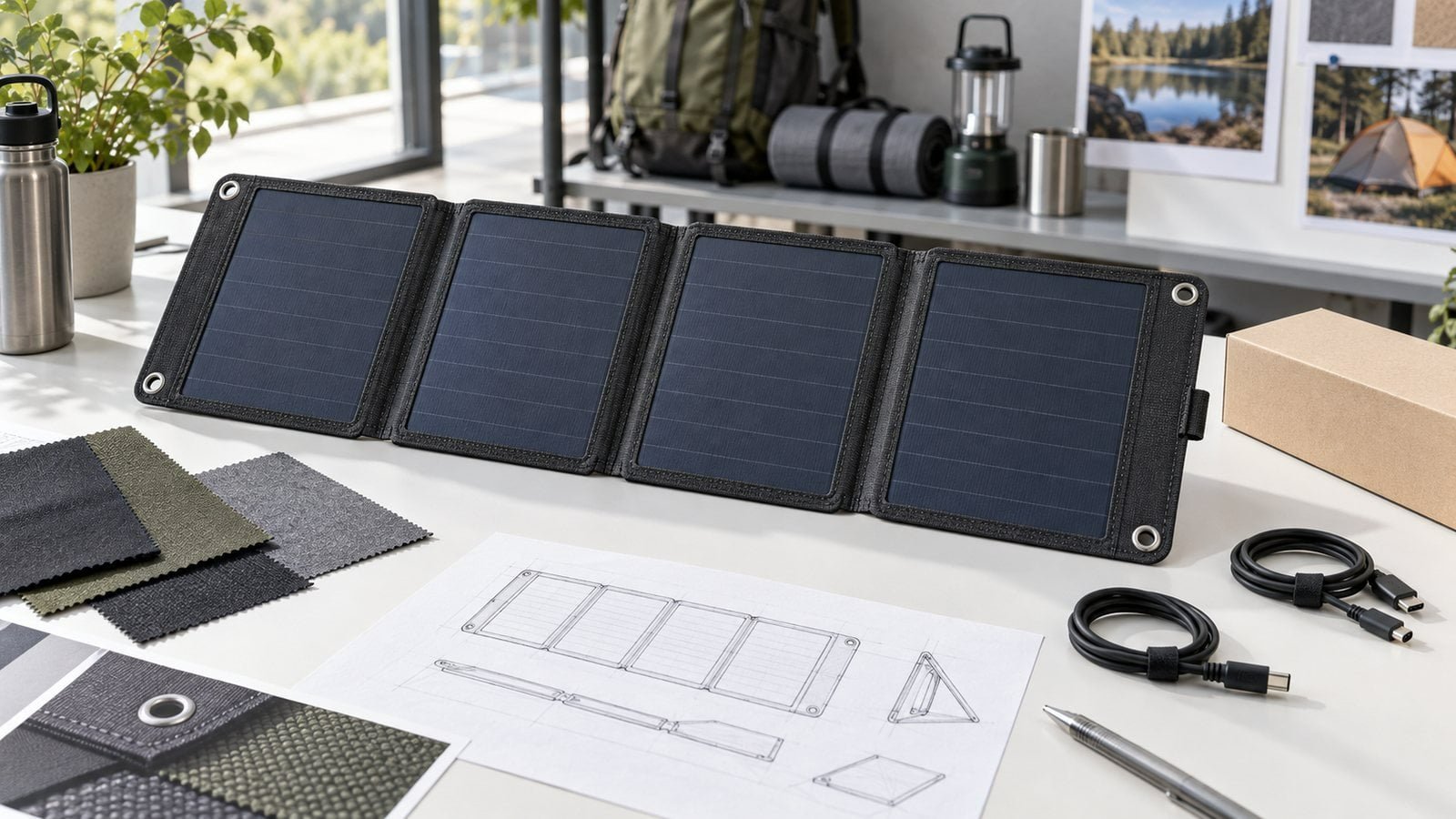
Hiking solar charger weight versus power is a product-design trade-off, not a contest to print the largest wattage on the smallest package. Buyers carry the complete product, but they benefit from energy only when the panel is deployed under useful conditions and its output suits the connected equipment.
For outdoor brands, we recommend writing the intended use before comparing constructions. A charger unfolded at a campsite serves a different routine from one attached to a moving backpack. That distinction affects size, handling and the way nominal power should be presented.
Describe when charging will happen
Define whether users will stop to charge, leave the panel at camp or try to use it while walking. Include the expected charging devices and whether a suitable power bank is part of the intended setup. Confirm compatibility rather than assuming that any USB-labelled product behaves the same way.
A moving backpack can expose a panel to changing orientation, shade and movement. A stationary deployment may offer more control over placement but requires suitable space and user time. Neither pattern should be represented by an unsupported daily-energy promise.
Measure the complete carried system
Compare total carry weight, including the panel, fabric or backing, closures, cables, adaptors and any required support. State what is included when comparing samples. A lighter bare panel can become a heavier usable kit after accessories are added.
Review how the assembly is handled with wet hands or gloves, and how it is secured during transport. A weight saving that removes necessary support or cable protection may introduce a different product risk.
Packed geometry affects usability
Record folded length, width, thickness, edge stiffness and where cables sit when the product is closed. Check the actual backpack pocket or storage area used by the target customer. Folded dimensions alone do not show whether a connector creates a bulky or vulnerable point.
Also inspect the opening sequence. Users should be able to deploy and repack the panel without repeatedly bending a cable at the same termination or loading the solar cells in an unintended way. The permitted folding zones belong to the complete product design.
Compare useful output under the same conditions
Rated panel power is useful when its test conditions are stated, but it is not the same as energy delivered to a device during a trip. Orientation, shade, temperature, output regulation and the receiving device affect the result.
Evaluate candidate samples with the same connected equipment and a repeatable test plan. Include changing illumination and the return of useful sunlight after shade. Observe whether the charging session resumes as intended rather than assuming that the receiver always recovers automatically.
Use a balanced comparison sheet
| Measure | Question it answers |
|---|---|
| Complete carry weight | What does the user actually carry? |
| Packed shape | Where can the product be stored and protected? |
| Deployed area | Can the user place and orient it in the intended setting? |
| Output behaviour | Does it work with the target device in changing light? |
| Handling trial | Can the product be opened, attached and repacked consistently? |
Choose features from the routine
Attachment points, stands, pockets and adaptors add function and mass. Keep features that solve a defined use problem. Test the position of hanging points against the intended orientation and ensure that the cable does not become a structural support.
For branded projects, approve packaging and instructions with the product. Explain the conditions for useful charging and the supported connection method. Avoid a claim of charging every device or achieving a fixed result in any weather.
Make the field trial representative
Ask testers to follow the intended routine and record deployment time, placement, connected equipment and interruptions. Combine their observations with controlled electrical and handling tests. A field photograph is useful context, but it does not replace measured results.
Discuss our hiking solar charger options and read the OEM foldable-charger development guide. Tell us the target carry weight, packed envelope and charging routine so we can compare practical design options with you.