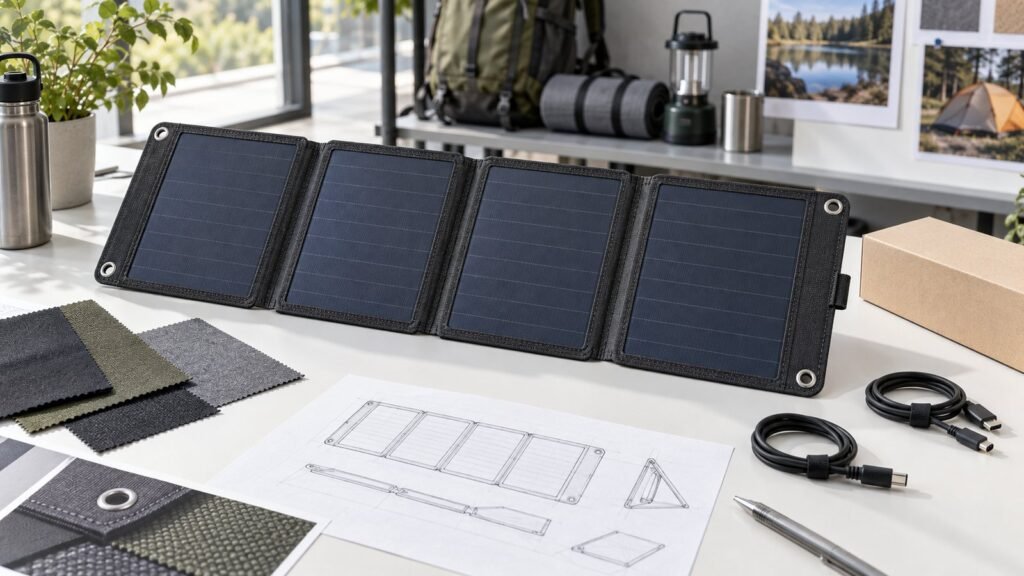
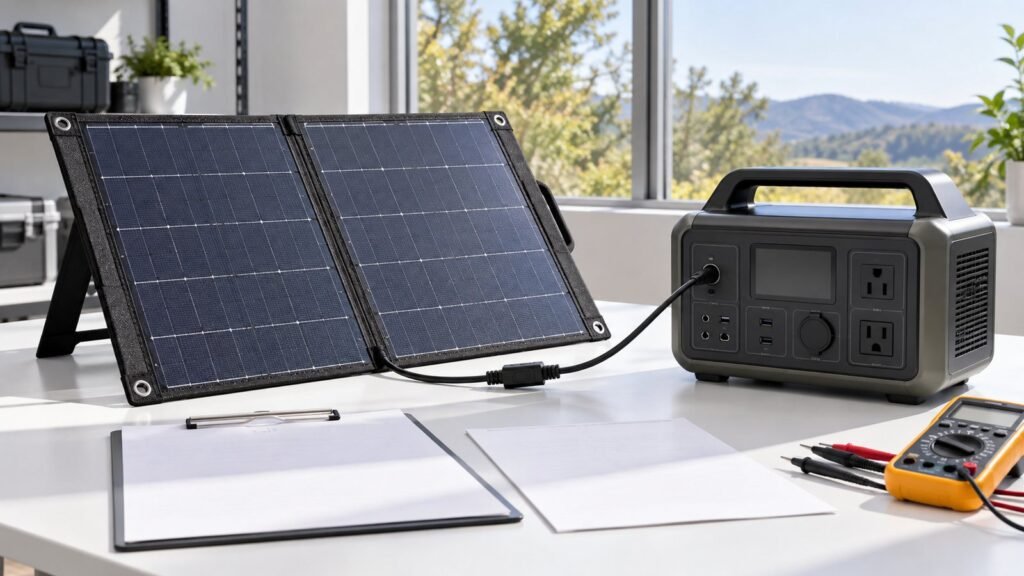
A hiking solar charger may work well on a test stand yet spend most of its life clipped to a moving pack, partly folded or shaded by a strap. Solar charger attachment design determines whether the user can present the panel to light without tearing a seam, blocking cells or putting force into the output cable.
The attachment points are part of the product architecture. Their number, location and construction should come from the intended carry and charging modes, not from a generic pattern of eyelets placed around the edge.
Describe how the panel will actually be used
Decide whether the product is primarily laid flat at a rest stop, hung from a tent, attached to a backpack while walking, or used in several modes. Show each mode in a simple sketch with the panel unfolded, the cable connected and the user’s equipment in place. Mark the expected direction of pull and the areas that may be shaded.
The hiking solar charger range is a starting point for power and form-factor discussion. A buyer brief should still state which carry modes are required and how long the panel is expected to remain attached during movement.
Keep loads out of the active module
An eyelet in fabric, a webbing loop and a reinforced corner create different load paths. The attachment should transfer tension through the designed border or backing structure, not into the cell laminate, interconnects or edge seal. Specify the reinforcement material, stitch or bond pattern, edge distance and allowed pull direction.
A single top corner may cause the panel to twist. Four points can hold orientation but add weight and setup time. Test the minimum arrangement that provides useful adjustment. Make sure carabiners or hooks cannot rub the front surface when the charger is folded or packed.
Consider light and cable routing together
The most convenient clip location is not always the best solar orientation. A panel fixed tightly to a backpack may face away from the sun for much of a walk or be shaded by a lid. Give users a practical way to reposition it without disconnecting the output. Avoid promising a daily energy yield based on a laboratory rating.
The cable should leave the panel without becoming an unintended tether. Define a strain-relief route, storage position and connector protection for both open and folded states. A cable caught under a strap can pull on the port each time the user moves. The custom cable and connector guide explains the electrical interface; the attachment review checks its mechanical behavior.
Write a field-oriented test plan
Test several representative backpacks, tent loops or mounting surfaces rather than one ideal fixture. Include repeated attachment and removal, walking vibration, a pull in the likely directions, wet handling if applicable, folding after use, and packing with the supplied cable. Record visible damage, loosened reinforcement and any loss of electrical continuity.
| Use mode | Design question | Evidence |
|---|---|---|
| Moving backpack | Does the panel stay oriented without flapping into the wearer? | Field photos and retention test |
| Static hanging | Can the panel be tilted without stressing one corner? | Setup trial with full cable path |
| Packed carry | Do clips contact cells or wear the surface? | Repeated pack/unpack inspection |
Set actual forces, cycle counts and acceptance limits from the product’s risk and expected use. One demonstration walk is useful for finding problems but is not a durability qualification.
Include attachment details in the OEM brief
Provide an unfolded and folded drawing, a defined clip or strap interface, expected accessories, materials and target weight. Photograph the intended field arrangement. Ask the supplier to show how reinforcement is made and inspected in production. The broader OEM foldable charger development guide covers the remaining electrical and packaging decisions.
If you are developing a hiking charger, share the use modes and pack interface with SiborTech. Those details make attachment design a measurable product requirement rather than a cosmetic feature.