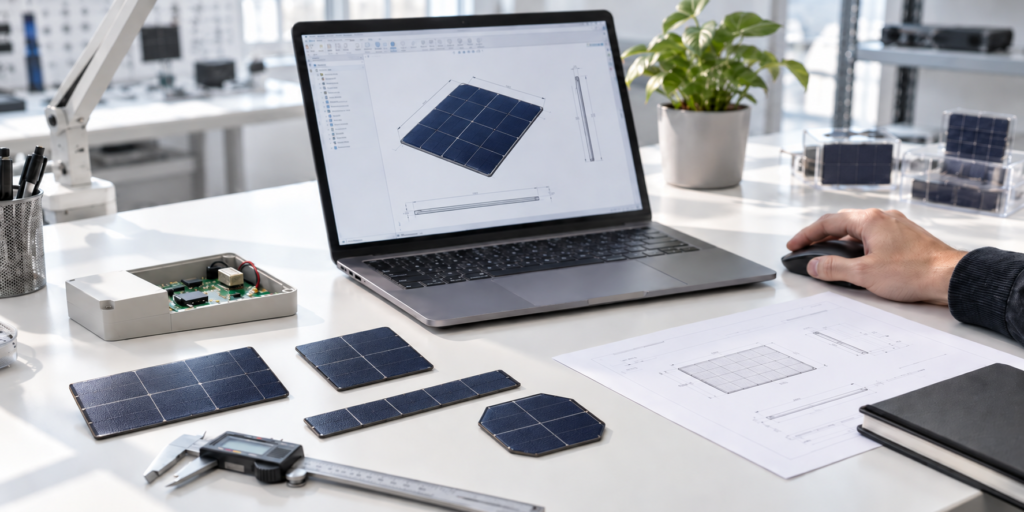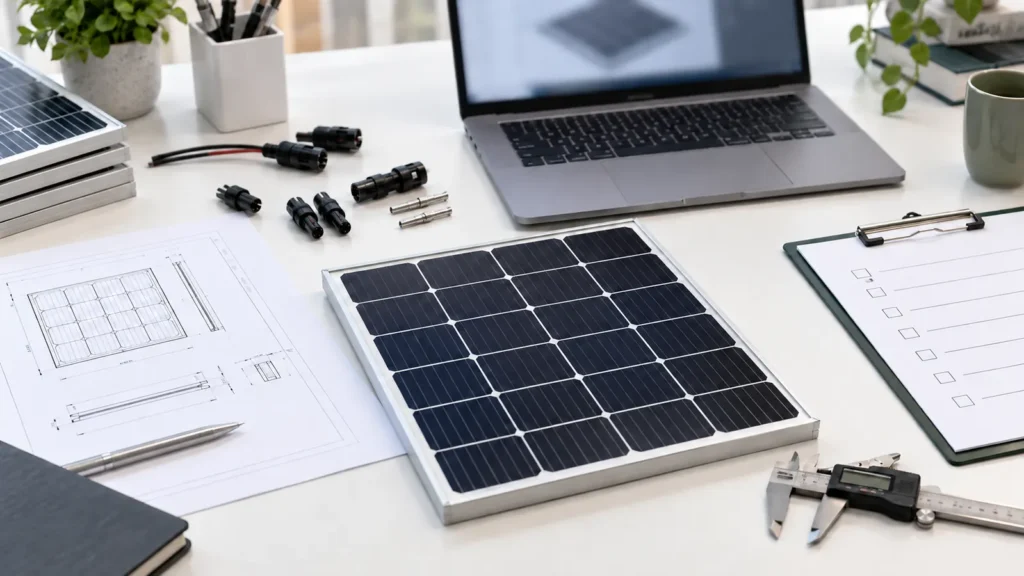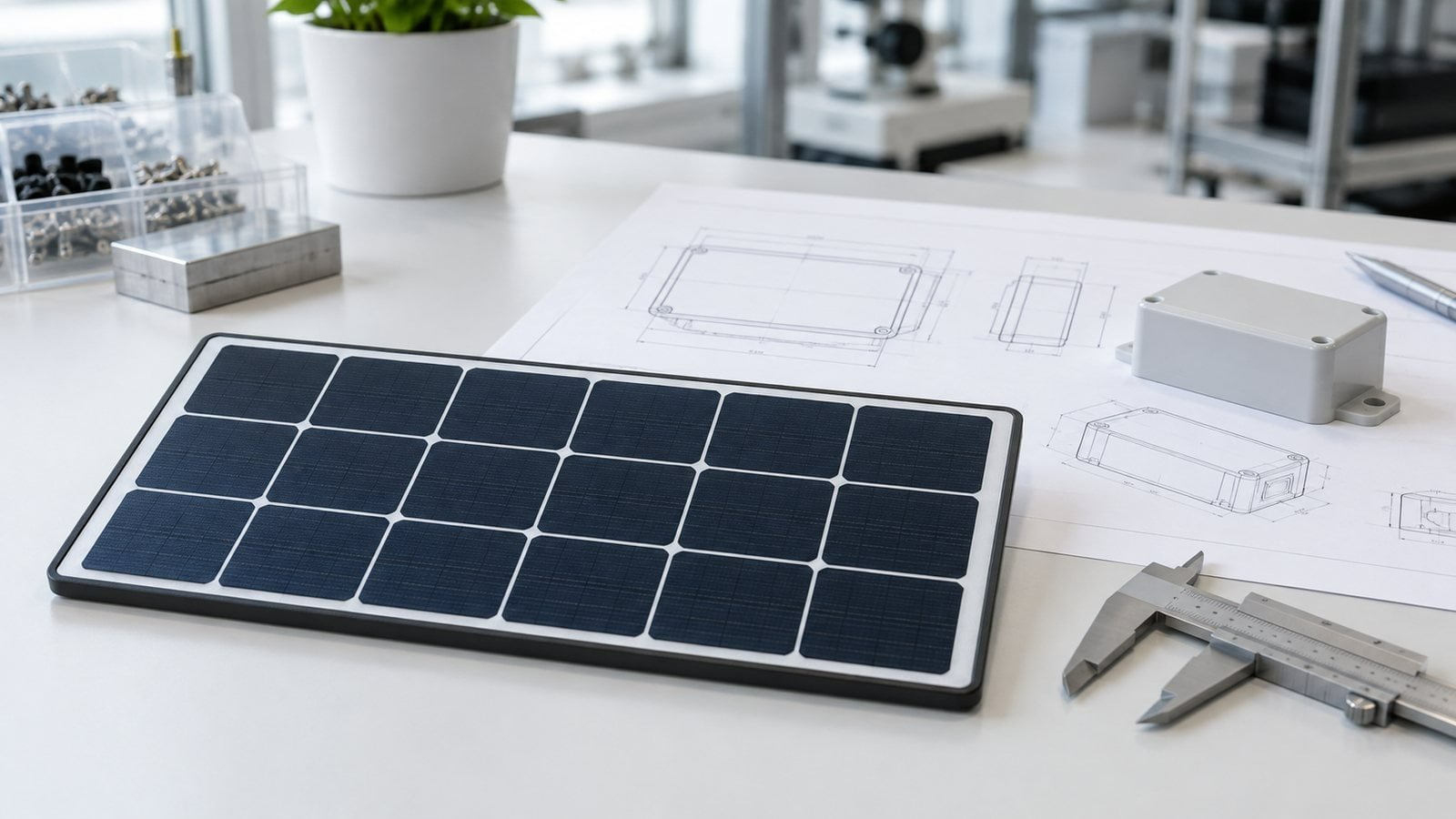
For a compact OEM product, the monocrystalline-versus-polycrystalline decision is mainly a question of usable power within limited area, supply availability, appearance, and total module construction. The comparison should not be reduced to a generic claim that one cell type is always better.
This guide focuses on small custom modules for sensors, trackers, cameras, portable electronics, and embedded products rather than residential rooftop panels.
What Is the Difference Between Monocrystalline and Polycrystalline Silicon?
Monocrystalline cells are cut from silicon with a continuous crystal structure. Polycrystalline cells contain multiple crystal regions. Those material structures influence cell performance and appearance, but the finished module also depends on cell grade, cutting, interconnection, encapsulation, active area, and production control.
Monocrystalline cells commonly appear dark and visually uniform. Polycrystalline cells often have a bluer, more textured appearance. The exact color can vary with coatings, cell format, and viewing angle.
Why Compact Products Change the Comparison
Large solar projects can add more module area when a design needs more power. A small electronic product may have a fixed enclosure, antenna position, display, and mounting surface. When the installation area cannot grow, output per unit area becomes more important.
This is one reason monocrystalline cells are frequently considered for small custom solar panels. However, the usable result must be evaluated at module level. Cell spacing, borders, cutouts, surface transmission, and series layout can reduce the portion of the product surface that actively generates power.
Power Density and Available Area
Product teams should compare candidate modules at the same external dimensions and under the same test conditions. Comparing a premium monocrystalline cell with a different-size polycrystalline module does not isolate the effect of cell technology.
Ask for the proposed active area, module dimensions, maximum-power voltage, maximum-power current, and test conditions. For a truly space-constrained design, a small improvement in usable module output may be valuable. For a product with generous area and a modest energy requirement, the difference may not justify redesign or supply-chain complexity.
Appearance and Industrial Design
Visible solar cells can become part of the product’s identity. A dark, relatively uniform monocrystalline surface often integrates well with black housings, cameras, trackers, and modern electronics. Polycrystalline cells may show more visible crystal variation.
Appearance should be approved using physical samples. Cell color, busbars, cut edges, adhesive patterns, surface texture, and reflections may look different from a CAD rendering. If visual consistency is important, include acceptable appearance criteria in the approved specification.
Cell Cutting and Custom Shapes
Compact modules often use cut cell pieces to create the required voltage, current, and geometry. The cutting method, edge quality, handling, and interconnection process can affect yield and reliability. A highly irregular outside shape does not mean the silicon itself can fill every part of that shape efficiently.
Provide the panel outline, active-area priority, keep-out zones, holes, and cable exit. The supplier can then propose a practical cell pattern. Rounded corners and external laminate shapes are normally easier to accommodate than a layout with many narrow internal cutouts.
Voltage Is Determined by Layout
Cell type alone does not define module voltage. Voltage depends mainly on the number and arrangement of cell sections connected in series. Current depends on cell area, illumination, and the parallel configuration.
The correct design should match the charging circuit’s operating window. Share the charging IC, battery chemistry, input limits, and target voltage with the module supplier. A module that fits mechanically but operates outside the useful input range can waste available area.
Low-Light Claims Need Careful Testing
General statements about low-light performance are often too broad for product design. Output depends on irradiance, spectrum, temperature, cell technology, module construction, and the electrical operating point. Two products described as monocrystalline can still behave differently.
For outdoor products, test representative cloud, shade, angle, and seasonal conditions. For devices that also receive indoor light, do not estimate performance from an outdoor watt rating. Test the proposed module under the actual lamp type and illuminance.
Temperature and Operating Environment
All silicon photovoltaic devices change electrical behavior with temperature. The design must leave suitable voltage margin for the charging circuit across the expected temperature range. Do not select a module only from room-temperature measurements.
Environmental durability depends more on the complete laminate than on mono versus poly alone. Surface material, encapsulant, backsheet, edge sealing, cable exit, adhesive, and mounting method determine how the module responds to UV, humidity, vibration, and handling.
Cost and Supply Considerations
Compare total project cost rather than cell price alone. A lower-cost cell option may require more area, a larger enclosure, or a different industrial design. A higher-output option may reduce panel dimensions but introduce stricter sourcing or appearance requirements.
Ask about cell availability for repeat orders and the change-control process. If the cell model, appearance, or electrical characteristics change, the supplier should communicate the change before production. For long-running OEM products, a controlled replacement and requalification process is more valuable than an unverified promise of permanent availability.
Surface and Encapsulation Still Matter
The same monocrystalline cells can be used in a rigid glass module, a lightweight ETFE laminate, or a more protected PET construction. These formats serve different products. A camera exposed outdoors, a tracker bonded to a container, and an indoor handheld device do not require the same module stack.
Use the operating environment to select the construction. For lightweight laminates, the existing ETFE versus PET guide provides a practical comparison. Glass and lightweight laminates should be compared separately because they differ in rigidity, weight, impact behavior, and integration.
Which Cell Type Should an OEM Team Choose?
Monocrystalline may be the better starting point when:
- The available panel area is tightly limited.
- A dark, uniform appearance supports the product design.
- The project needs strong outdoor output from a compact footprint.
- The proposed cell format and supply can be controlled through production.
Polycrystalline may still be considered when:
- The product has sufficient installation area.
- Cost is more important than maximum output per unit area.
- The appearance is acceptable or the panel is not prominently visible.
- A suitable, stable cell supply is already qualified.
The final choice should be made from module samples built to the same dimensions and evaluated in the actual product.
Prototype Comparison Checklist
- Use identical outside dimensions and connector configuration.
- Measure output under the same light, temperature, angle, and load.
- Compare charging behavior with the actual power electronics.
- Inspect cell spacing, cut quality, color, and surface finish.
- Test partial shading and unfavorable installation angles.
- Evaluate adhesion, vibration, temperature, humidity, and handling as required.
- Record the exact cell and laminate construction for each sample.
Frequently Asked Questions
Are monocrystalline cells more suitable for small solar panels?
They are often a strong choice where usable area is limited, but module-level performance and system matching should be verified with the proposed construction.
Does monocrystalline always perform better in shade?
No universal conclusion should be made from the material name alone. Cell layout, shading pattern, irradiance, and electronics all affect the result.
Can both cell types use ETFE or glass?
Yes. Cell technology and surface construction are separate design decisions, although manufacturing compatibility must be confirmed.
Is module efficiency the same as cell efficiency?
No. Module efficiency also reflects spacing, borders, interconnections, optical losses, and the full external area.
Should we approve the cell specification or the finished module?
Both matter, but the finished module and its production specification should control the product-level result.
Compare Finished Designs, Not Labels
For compact products, monocrystalline silicon often provides a useful combination of power density and appearance. The decision still needs to include module dimensions, electrical matching, construction, application environment, cost, and supply control.
Review SiborTech’s custom solar application scenarios, then share your available area, charging circuit, light conditions, and mechanical requirements. Discuss a custom solar module before selecting the final cell and construction.